
Airbnb is legal in Dubai, but only for properties that hold a Holiday Home Permit from the Department of Economy and Tourism (DET). The permit applies to every unit you list, whether you own it or rent it. Your building’s own rules and your sale agreement can still say no. This guide walks through who can apply, what you submit, what it costs, what happens if you skip it, and how to check a property before you buy it for short-term letting.
TL;DR
- Any Dubai home let out to guests as a short stay must be registered with DET and hold a Holiday Home Permit before it appears on Airbnb or any similar platform.
- The annual permit fee is AED 300 per bedroom, capped at AED 1,200 per holiday home, with inspection and classification fees on top.
- Operating without a permit carries a fine of AED 5,000, which can double for a repeat violation within a year.
- A permit does not override your building, community or sale and purchase agreement. Check those first, ideally before you buy.
- Private and shared rooms cannot be listed in residential property, only whole units.
Table of Contents
- Is Airbnb legal in Dubai?
- Who can apply, and what you submit
- What a Dubai holiday home permit costs
- Rules you must follow once you are listed
- Penalties for listing without a permit
- Can a building or community still say no?
- Short-let or long-let: which suits you
- Our view: buy the rules, not just the unit
- Looking at a Dubai or Ras Al Khaimah home for letting?
- A pre-listing checklist
- FAQ
- Sources
Is Airbnb legal in Dubai?
Yes, with conditions. Dubai regulates holiday homes through Decree No. 41 of 2013 and Administrative Resolution No. 1 of 2020, which Airbnb’s own Dubai guidance also names, alongside DET’s Holiday Homes Guide. The rules treat a short-stay let the same way whichever platform you use. Airbnb, Booking.com or a direct booking all fall under the same permit requirement.
The practical consequence is simple. You cannot list first and regularise later. The permit comes first, and the permit number is what a compliant listing is built around.
What counts as a holiday home
A holiday home is a residential unit rented to guests for short stays rather than on a standard tenancy. A UAE property guide describes the threshold as any let of less than six months at a time. If your plan is month-to-month or multi-month guests, check which side of that line you are on before you assume a standard tenancy applies.
The regulator has also been renamed over the years. You will see DTCM (Dubai Tourism and Commerce Marketing) in older documents and on the 2020 resolution. Today the body is the Department of Economy and Tourism, DET. The two names point to the same permit system.
Which units can be registered
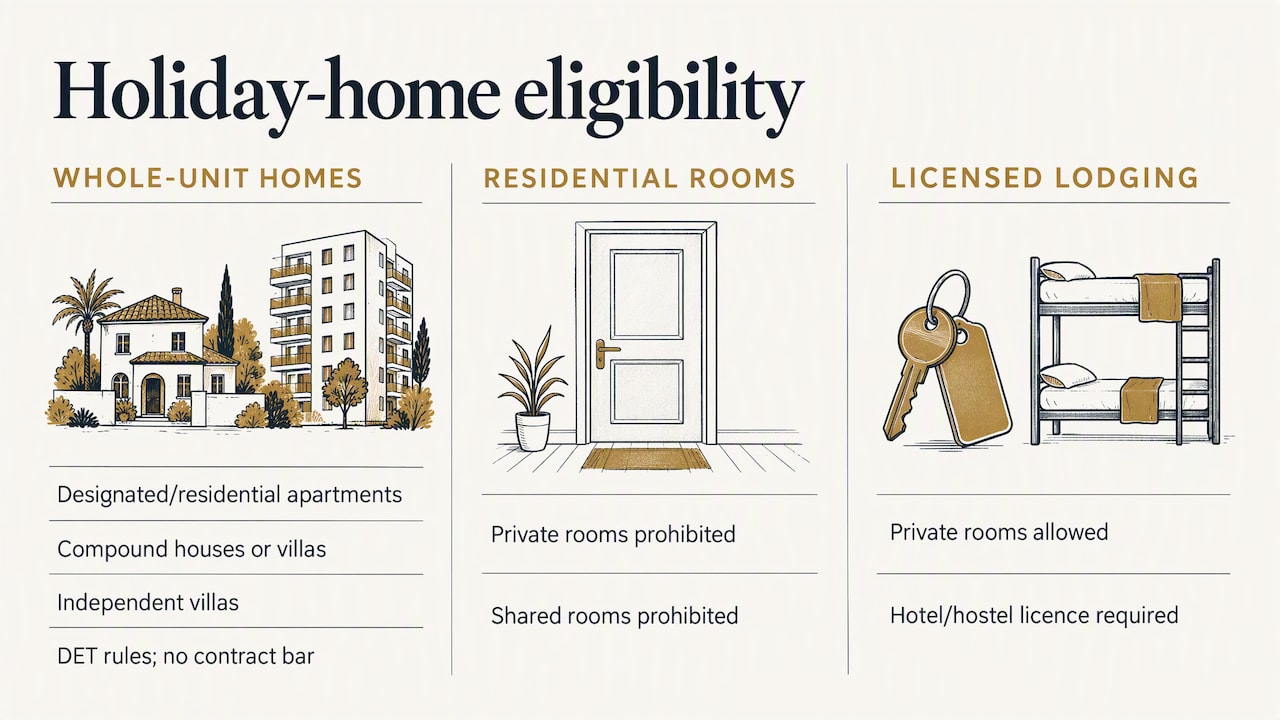
The 2020 resolution allows apartments in buildings designated for the activity or in residential buildings, houses or villas in a real-property compound, and independent villas. The unit must also meet DET’s technical requirements, and the sale and purchase agreement must not expressly bar holiday-home use.
One firm limit applies to what you can offer. Private rooms and shared rooms are not allowed in residential properties. A private room can be hosted only in a licensed hotel or hostel. So “renting out a spare bedroom in my flat” is not a route Dubai allows.
Who can apply, and what you submit
The permit sits with a registered operator. According to Airbnb’s summary of the Dubai rules, individual owners can register and manage up to 8 units. Managing more than that requires a professional trade licence from DET, which is the route a holiday-home management company takes.
The process runs in two stages:
- Register as a holiday-home operator. You create your operator profile with DET, using your personal details, passport copy and Emirates ID.
- Apply for a permit for each property. You submit the unit details and proof that you can dispose of it.
For the unit itself, the 2020 resolution asks for a valid passport or Emirates ID of the owner or tenant and proof of the right to dispose of the unit. In practice that means:
- the title deed if you own the unit, which our guide to the Dubai title deed explains step by step;
- a landlord’s No Objection Certificate (NOC) if you are a tenant;
- a developer or owners association NOC where your building’s rules require one for short stays;
- photographs of the furnished unit, which DET uses for classification.
A tenant can apply only with the landlord’s written consent. Subletting a unit as a holiday home without it breaches your lease. Always confirm the current document list on DET’s official portal before you start, because requirements are updated from time to time.
What a Dubai holiday home permit costs
The fee schedule in Executive Council Resolution No. 49 of 2014 sets the annual permit fee at AED 300 per bedroom, up to a ceiling of AED 1,200 per holiday home. Inspection and classification fees apply as well.
| Unit | Annual permit fee |
|---|---|
| Studio or 1 bedroom | AED 300 per bedroom |
| 2 bedrooms | AED 600 |
| 3 bedrooms | AED 900 |
| 4 bedrooms or more | AED 1,200 (the cap) |
The table applies the per-bedroom rate and the cap from the resolution to each size. DET can revise fees, so treat the figures as the baseline and confirm the current amounts on the official portal when you apply.
Costs beyond the permit
The permit fee is the smallest cost of running a short-stay unit. Plan for these as well:
- Insurance. Licensees must submit a comprehensive insurance policy from a company licensed in the Emirate to cover potential guest damage.
- Tourism Dirham. Hosts must collect the Tourism Dirham fee from guests and remit it to DET. Check DET’s portal for the current nightly rate per bedroom and how it is charged.
- Platform and management fees. Airbnb’s service fee and, if you hire an operator, their commission come out of your gross income.
- Furnishing, cleaning and utilities. A guest-ready unit costs more to run than a long-let.
On tax, speak to a qualified UAE tax adviser about VAT registration and corporate tax on your rental income. The treatment depends on your income level and how you hold the property, so a general rule is not safe here.
Rules you must follow once you are listed
The permit comes with ongoing duties. Administrative Resolution No. 1 of 2020 sets several that surprise first-time hosts:
- A complaints policy. Operators must establish a formal policy for processing guest complaints and display it prominently for guests.
- No surprise charges. Licensees are prohibited from charging guests additional costs beyond those explicitly agreed in the lease contract. Cleaning fees, deposits and extras should be stated up front.
- Whole units only. As noted, no private or shared rooms in residential property.
Clear house rules help in practice too: quiet hours, maximum occupancy, pool and gym etiquette, and parking. Neighbours’ complaints are the usual way a short-stay unit comes to the attention of a building manager.
Penalties for listing without a permit
Operating a holiday home without a licence is a violation punishable by a fine of AED 5,000 under Executive Council Resolution No. 49 of 2014. A repeat violation within a year can double the fine. DET may also issue warnings, suspend the activity for up to six months, or revoke the licence.
For an investor the larger risk is lost income. A suspended permit means empty calendars during the months you were counting on, while your mortgage and service charges carry on. Our guide to the mortgage registration fee in Dubai is a useful reminder of the fixed costs that sit under any rental plan.
Can a building or community still say no?
Yes. Freehold ownership does not override community rules. As one UAE permit guide puts it, some owners associations and developers restrict or ban short-term letting regardless of ownership, and an owner must hold the DET permit and comply with any community restriction. DET’s permit and your building’s rules are two separate gates.
Before you buy or list, check these in order:
- The sale and purchase agreement. The 2020 resolution requires that it does not expressly bar holiday-home use.
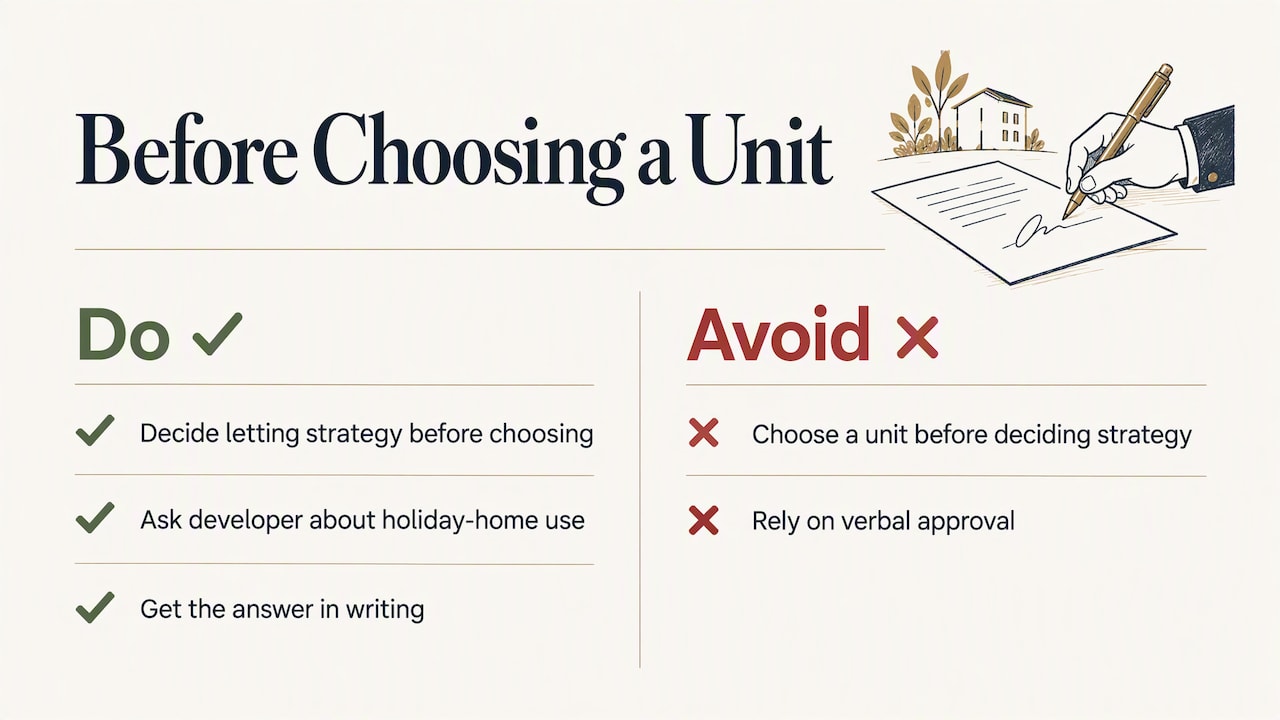
- The building or master-community rules. Ask the developer or owners association whether short stays are allowed, and whether an NOC or an extra fee applies.
- Your mortgage and lease terms. If you finance the purchase or rent the unit, read what they say about short-term use.
- The unit itself. Confirm it meets DET’s technical requirements and that you can arrange the required insurance.
Get the building’s answer in writing. A verbal “it should be fine” from an agent is not evidence.
Short-let or long-let: which suits you
A short-stay unit can earn more per month than a standard tenancy, but it is a business rather than a passive holding. You are handling guest turnover, pricing, cleaning, permits and renewals, or paying an operator to do it. Occupancy swings with the tourist season, so income is less predictable than a 12-month tenancy.
| Factor | Holiday home | Standard long-let |
|---|---|---|
| Permit | DET Holiday Home Permit, renewed annually | Tenancy contract registration |
| Income pattern | Variable with season and occupancy | Fixed annual rent |
| Running effort | High, or operator commission | Low |
| Building restrictions | Can be banned by community rules | Rarely an issue |
| Insurance | Guest-damage cover required | Standard landlord cover |
If you want a steadier return and little day-to-day work, a long-let in a well-designed building is often the calmer choice. Energy-efficient design lowers running costs for either model, and our guide to energy efficient apartments in Dubai shows what to look for.
Our view: buy the rules, not just the unit
We develop boutique residential buildings in Dubai and Ras Al Khaimah, and investors ask us about short-term letting often. Our answer is always the same: decide your letting strategy before you pick the unit, not after handover.
The permit is the easy part. It is a form, a fee and an inspection. The harder questions are in the paperwork you sign at purchase: what the sale agreement says about use, what the owners association allows, and how the building is managed. A beautiful apartment with the wrong use clause is a poor short-let and a frustrated owner.
We also think good design earns its place in either model. Smart-home systems, quality finishes and wellness amenities matter to a guest for a weekend and to a tenant for a year. Sustainable design, covered in our piece on sustainable apartment design in the UAE, lowers utility bills, which protects margins whichever way you let.
So before you commit to any development, ours included, ask the developer directly whether holiday-home use is permitted and get the answer in writing. We are happy to go through it with you for any of our projects.
— Mark
Looking at a Dubai or Ras Al Khaimah home for letting?
If you are comparing new developments with rental income in mind, start with our two current projects. Lazord by Lapis, a boutique residential building in Majan, starts from AED 750,000. Azure by Lapis starts from AED 790,000. Both are one-off purchase prices as published on our site.

Tell our team how you plan to use the home, as a residence, a long-let or a short-stay investment, and we will explain what applies to each project before you reserve. You can also read more on profitable investment in the UAE or enquire through our main site.
A pre-listing checklist
Use this list before your first guest books:
- Confirm your sale agreement and building rules allow short stays.
- Register as a holiday-home operator with DET.
- Apply for the permit for the specific unit, with title deed or tenancy and NOC, Emirates ID, passport and photographs.
- Arrange the required guest-damage insurance with a company licensed in Dubai.
- Set up a visible guest complaints policy.
- Publish your full price, including every fee, before the booking.
- Set up Tourism Dirham collection and payment to DET.
- Speak to a tax adviser about VAT and corporate tax.
- Put the permit number on your listing and diarise the annual renewal.
FAQ
Do I need a permit to list my Dubai apartment on Airbnb?
Yes. Every unit let to guests for short stays must hold a Holiday Home Permit from DET, and the rule applies to every booking platform. Listing without one risks a AED 5,000 fine and possible suspension.
How many properties can I register as an individual?
An individual owner can register and manage up to 8 units, according to Airbnb’s Dubai summary. Beyond that you need a professional trade licence from DET, as holiday-home management companies hold.
Can I rent out a single room?
No, not in residential property. Private and shared rooms are not allowed there, and a private room can only be offered in a licensed hotel or hostel. List the whole unit if it qualifies.
Can my building ban Airbnb even if I own the flat?
Yes. Owning the property outright does not override owners association or developer rules, and some communities restrict or prohibit short stays. Ask for the rule in writing and check your sale and purchase agreement before you apply to DET.
Can a tenant register a holiday home?
Only with the landlord’s written consent in the form of an NOC. Without it, subletting as a holiday home breaches the tenancy and can lead to eviction.
Sources
- Administrative Resolution No. (1) of 2020, Dubai Legislation Portal (HTML)
- Administrative Resolution No. (1) of 2020, Dubai Legislation Portal (PDF)
- Executive Council Resolution No. (49) of 2014, Dubai Legislation Portal
- Airbnb help: Dubai holiday home regulations
- Holiday Home Permit Dubai guide, UAE Expert Hub