Yes, you can get a mortgage in the UAE without living here. Banks lend to non-resident buyers and expatriates, but they lend less than they do to residents, ask for more paperwork and look closely at your income. Under the Central Bank rules, a first home valued below AED 5 million can be financed up to 80%, and an investment property up to 60%. This guide explains who qualifies, how much you must put down, what you will pay on top, and how financing fits an off-plan purchase.
TL;DR
- Banks in the UAE do lend to non-residents. Each sets its own income, document and nationality rules, so a single yes or no does not exist.
- The Central Bank caps loan-to-value for expatriates at 80% below AED 5 million, 70% above it, and 60% for a second home or investment property. Lenders can set tighter limits.
- Your deposit must come from your own funds, not from a personal loan or credit card, and total debt payments are limited to 50% of income.
- Budget for fees beyond the deposit, and ask the bank early how it treats off-plan units, because the terms can differ from those for completed homes.
- Start with a pre-approval before you reserve a unit, so your budget is based on a lender’s figures.
Table of Contents
- What “non-resident” means to a UAE lender
- Who can qualify
- How much you can borrow: loan-to-value and deposit
- Rates, tenor and the fixed-then-variable structure
- Costs beyond the deposit
- Documents to prepare
- From pre-approval to handover: the process
- Financing an off-plan unit
- Property types and locations: what to ask
- Mistakes that cost non-resident buyers time
- Our perspective
- Explore a Lapis home
- FAQ
- Sources
What “non-resident” means to a UAE lender
A non-resident, for mortgage purposes, is a buyer who does not hold a UAE residence visa and does not live in the country. An expatriate living here on a residence visa is a different case: you may hear “expat mortgage” and “non-resident mortgage” used as if they were the same product, but banks assess them differently, mainly because a resident’s income is paid and verified locally.
The Central Bank’s mortgage regulations distinguish between UAE nationals and expatriates when setting their ratios. Beyond that, each bank decides whether it will lend to someone living abroad, in which countries, and on what terms. That is why two non-resident buyers with similar salaries can get different answers from different banks.
The practical point: do not rely on a general headline such as “non-residents can borrow 50%” or “75%”. Ask for a written indication from the bank for your nationality, your income type and the property you intend to buy.
Who can qualify
Lenders publish their criteria, and they show the pattern. Three examples from bank pages:
- Salaried applicants. ADIB asks salaried non-resident applicants for a monthly salary of AED 15,000 and a three-month bank statement.
- Self-employed applicants. The same bank sets an annual turnover of AED 3,000,000 for business owners.
- Nationality rules. ADCB lists the nationalities eligible under its standard route. Applicants of other nationalities need 12 months of bank statements and tax returns attested by the UAE Ministry of Foreign Affairs, and self-employed lending is generally not open.
These are the published terms of individual banks, not rules that apply everywhere. They do show what you should prepare: stable, documented income in a convertible currency, a clean credit history and a clear source for your deposit.
The regulator also requires lenders to look beyond the property. Banks must not rely only on collateral value and must assess repayment capacity through verified income and recurring expenses. A valuable apartment does not compensate for weak income evidence.
How much you can borrow: loan-to-value and deposit
Loan-to-value (LTV) is the share of the property’s value the bank will finance. The Central Bank sets the ceilings for expatriates:
| Property | Maximum LTV | Minimum deposit |
|---|---|---|
| First home valued below AED 5 million | 80% | 20% |
| First home valued above AED 5 million | 70% | 30% |
| Second or subsequent home, or investment property | 60%, regardless of value | 40% |
These are ceilings, not promises. Lenders are free to be more conservative, and many are when a buyer lives abroad or the segment looks riskier. Treat the table as the best case and your bank’s offer as the real number.
A worked example
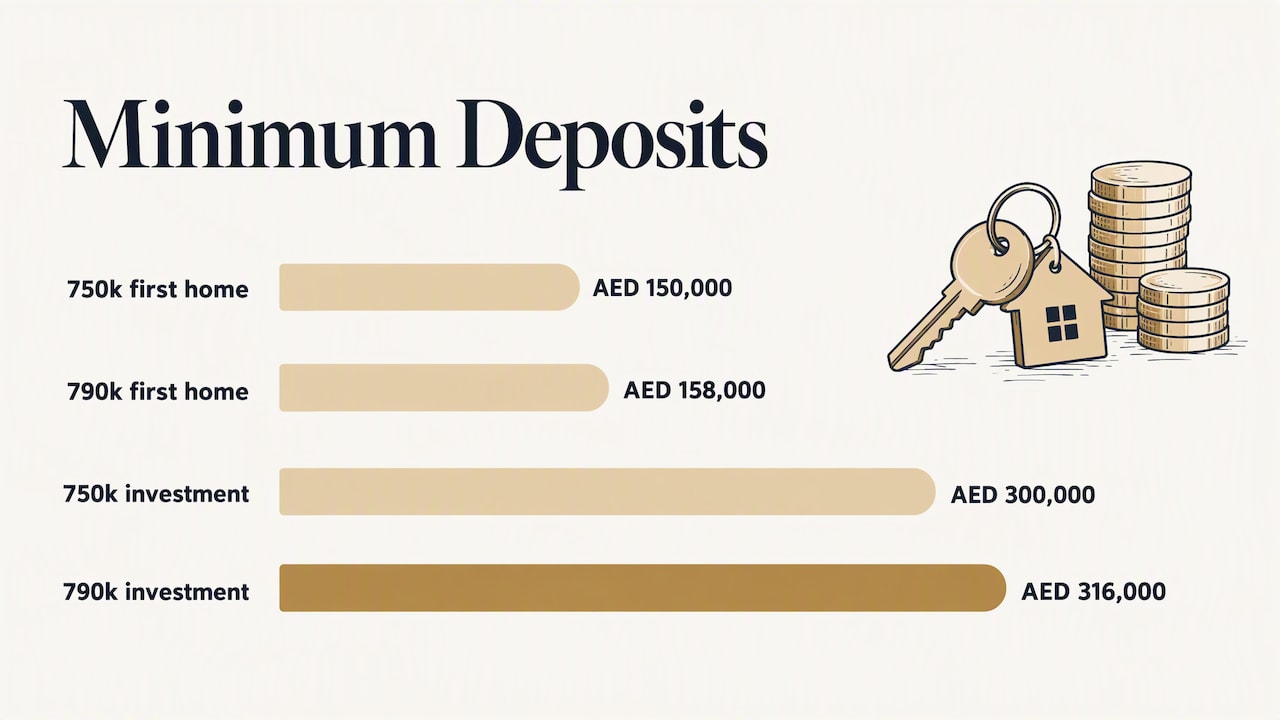
Take a unit priced at AED 750,000, the starting price of Lazord by Lapis. If the bank treats it as your first home at the full 80%, the maximum loan is AED 600,000 and the minimum deposit is AED 150,000. If it is an investment property at the 60% ceiling, the maximum loan is AED 450,000 and the deposit is at least AED 300,000.
For a unit at AED 790,000, the starting price of Azure by Lapis, the same ceilings give a deposit of at least AED 158,000 (first home) or AED 316,000 (investment). These sums cover the deposit only. Fees come on top, covered below.
Where the deposit must come from
Banks are required to make sure the down payment comes from your own funds, and not from other credit such as a personal loan or credit card. Keep the trail clear: savings statements, sale proceeds from another property, or documented gifts, with names and dates that match.
The income ceiling
The regulation caps the debt burden ratio at 50% of gross salary and regular income from a defined source. Everything you repay monthly, including the new mortgage, car loans and card balances, counts toward it. Paying down small debts before you apply can raise the amount a bank will approve.
Rates, tenor and the fixed-then-variable structure
The maximum mortgage tenor is 25 years, and each lender sets its own maximum age at the end of the loan. A buyer in their fifties will often be offered a shorter term than a buyer in their thirties, which raises the monthly payment.
Rates vary by bank, profile and date, so we do not quote one here. A common structure is a fixed introductory period followed by a variable rate. One bank’s key facts statement describes a fixed introductory rate followed by a variable rate linked to EIBOR, the UAE interbank benchmark, with processing, valuation and government registration fees listed as costs. When you compare offers, look at three things together: the introductory rate, the margin after it ends, and the cost of leaving early.
Costs beyond the deposit
Plan for these on any purchase financed by a bank:
- Bank charges: processing and valuation fees, as listed in the lender’s key facts statement.
- Government registration: the mortgage itself is registered, which carries a fee. Our guide to the mortgage registration fee in Dubai explains what it covers and who pays it.
- Ownership registration: the transfer of the property into your name. See how the title deed in Dubai is issued, what it costs and how to verify it.
- Insurance: lenders usually require property and life cover. Ask for the premium in writing.
Ask each bank for a full cost sheet before you compare headline rates. A lower rate with higher fees can cost more over the first years.
Documents to prepare
The list depends on the bank, but ADIB’s published requirements give a realistic baseline for salaried applicants: a passport with a copy of the residence visa, a salary certificate, a three-month bank statement and the property ownership documents. Self-employed applicants provide company ownership documents in place of a salary certificate.
As a working checklist, have these ready before you apply:
- Passport and visa or residence documents.
- Proof of income: salary certificate or company documents.
- Bank statements, three months at minimum, and 12 months where the lender asks for them.
- Proof of deposit funds and where they came from.
- Tax returns, attested where your nationality requires it.
- The sales agreement or reservation form for the property.
Official documents issued abroad may need translation or attestation. Ask the bank which ones before you spend time on them.
From pre-approval to handover: the process
- Get a pre-approval. You give the bank your income details and receive an indicative maximum loan. It tells you your budget and which units are realistic.
- Choose and reserve the property. Reserve only within your approved range.
- Valuation. Before an irrevocable lending commitment, a qualified third party independent of you, the seller and the developer must carry out an independent on-site valuation. The Central Bank also advises that appraisals should not build in speculative future price rises, so the valuation can come in below the price you agreed. Be ready to cover any gap from your own funds.
- Final offer and signing. You receive the offer letter, review the terms and sign.
- Registration and completion. The mortgage is registered and the title is issued.
Timings differ by bank and by how complete your file is. A full file at the start shortens the process more than any other step.
Financing an off-plan unit
Most new developments are sold off-plan, and bank financing for an unfinished building is not the same as for a completed apartment. Many buyers pay the developer through a staged payment schedule during construction and arrange the mortgage nearer handover. Others find lenders apply tighter limits to units that are not yet complete. Because terms vary, ask your bank directly: will it finance this unit before completion, and at what LTV?

If you plan to buy and rent the unit out, factor in that an investment property sits at the 60% ceiling, and read the rules on short lets first in our guide to Airbnb regulations in Dubai.
Property types and locations: what to ask
Lenders decide which properties and areas they will finance, and they normally want a completed or approved project from a recognised developer, in a freehold area where foreigners can own. Ask each bank for its list of accepted developments before you pay a reservation fee. That one question saves buyers from discovering at valuation stage that a lender will not finance their chosen building.
Mistakes that cost non-resident buyers time
- Reserving before pre-approval. You may find the bank lends less than you assumed.
- Ignoring the valuation gap. If the valuer sees a lower value than your price, the loan is calculated on the lower figure.
- Using borrowed money for the deposit. Lenders must check the source and will refuse it.
- Comparing rates only. Fees, the post-introductory margin and early settlement terms matter as much.
- Leaving documents until the last week. Attestation and translation take time.
Our perspective
A mortgage works best when it follows a decision about the home, not the other way round. We see buyers start with the loan and then look for a property that fits it. We suggest the reverse: choose the right building first, then ask what financing is realistic for it.
At Lapis Properties we build boutique residential towers, with private plunge pools, smart-home integration, premium finishes and wellness amenities, and we design them with sustainability in mind. A smaller development means fewer units, closer attention to detail and a more personal buying experience. When you are weighing a purchase from abroad, that personal service matters: you can ask us questions directly and get a clear answer on the unit, the payment plan and the next step.
Our advice is to confirm your budget with a lender before you reserve, keep your deposit funds well documented, and take your time comparing the full cost sheets. A good purchase is one you can comfortably hold for years, as a home or as a profitable investment with lasting value.
Mark
Explore a Lapis home
If you are ready to match your budget to a property, two of our developments start below the AED 5 million threshold that sets the higher LTV band. Lazord by Lapis starts from AED 750,000, and Azure by Lapis starts from AED 790,000.

Both are designed around waterfront living with passion and precision. Tell us your budget, and whether you are buying a home or an investment, and our team will walk you through availability and the payment plan. You can start from our projects page or contact us to schedule a call.
FAQ
Can a non-resident get a mortgage in the UAE?
Yes. UAE banks lend to non-residents, although each sets its own eligibility rules on income, nationality and documents. The Central Bank’s ratios apply to all lenders, and banks can be stricter. Ask for a pre-approval before you choose a property.
What is the minimum deposit for a non-resident?
For an expatriate’s first home below AED 5 million, the maximum LTV is 80%, so the minimum deposit is 20%. For a second home or investment property the ceiling is 60%, so you need at least 40%. Your bank may ask for more, and you must also budget for fees.
What income do I need?
It depends on the lender. One bank publishes a minimum monthly salary of AED 15,000 for salaried non-resident applicants, and an annual turnover of AED 3,000,000 for the self-employed. Other banks set different thresholds, so check the one you apply to.
How long can the loan run?
The regulation sets a maximum tenor of 25 years. The bank also applies its own maximum age at the end of the loan, which can shorten the term for older applicants.
Can I use a personal loan for the deposit?
No. Lenders must ensure the down payment comes from your own funds and not from other credit facilities such as personal loans or credit cards.
Sources
- ADIB: Non-Resident Mortgage in UAE
- ADCB: Standard Mortgage Home Loans
- CBUAE Rulebook: Article 3, Important Ratios
- CBUAE Rulebook: Regulations Regarding Mortgage Loans (detail)
- CBUAE Rulebook: Regulations Regarding Mortgage Loans
- CBD: Key Facts Statement, Mortgages