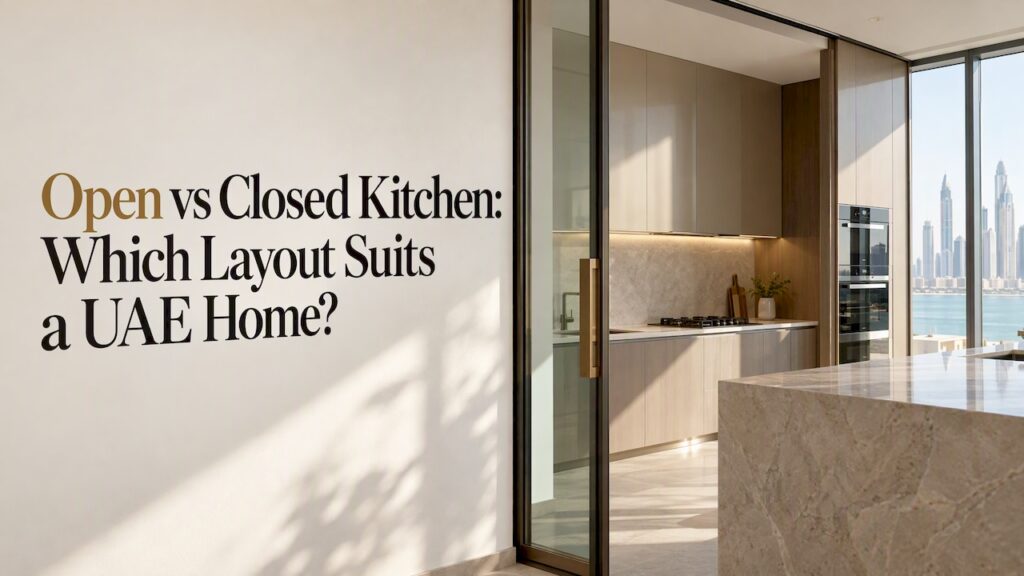
An open kitchen gives you light, space and a place to host. A closed kitchen gives you walls, a door and control over smoke, noise and heat. In the UAE, where air conditioning runs most of the year and many households cook with oil and spices every day, the right answer depends less on trends than on how you actually cook. This guide compares the two layouts honestly, adds the semi-open middle ground, and gives you a short checklist to use before you buy or sign off a floor plan.
TL;DR
- Choose an open kitchen if you cook lightly, entertain often and want a bright, connected living space.
- Choose a closed or semi-closed kitchen if you cook daily with oil, spices or frying, or want to keep noise, heat and mess out of sight.
- A hybrid, such as an open show kitchen plus a small closed wet kitchen, suits many UAE households that both host and cook seriously.
- Whatever you pick, ducted extraction matters more than the layout itself: ask what the unit has before you commit.
- Glass partitions or sliding doors let you open or close the space as the moment requires.
Table of Contents
- What is the difference between an open and a closed kitchen?
- Open kitchen: pros and cons
- Closed kitchen: pros and cons
- Open vs closed kitchen at a glance
- Why the UAE changes the answer
- The hybrid: show kitchen plus wet kitchen
- Ventilation: the detail that decides how it feels
- How to choose: six questions
- Our perspective
- Choosing a home with the right kitchen
- Common mistakes to avoid
- FAQ
- Sources
What is the difference between an open and a closed kitchen?
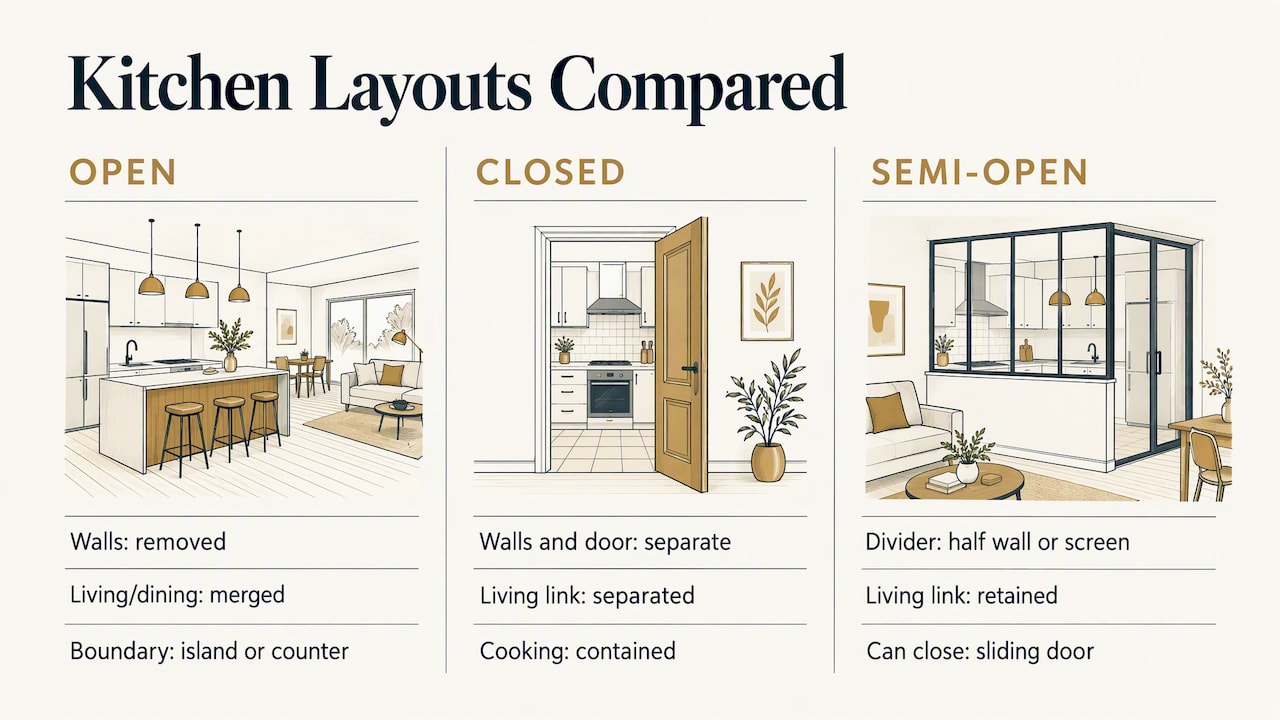
An open kitchen merges the cooking area with the living and dining zones, removing walls so the space reads as one large room. It often comes with an island or breakfast counter that acts as the boundary. A closed kitchen is a self-contained room, separated by walls and a door for privacy and containment.
Between the two sits the semi-open kitchen: a kitchen partly divided by a half wall, a pass-through, a glazed screen or a sliding door. It keeps a visual link with the living area while giving you something to close when the pan is hot.
None of these is better in the abstract. Each trades one set of comforts for another, and the trade looks different in a Dubai or Ras Al Khaimah apartment than in a house in a temperate climate.
Open kitchen: pros and cons
What an open kitchen does well
- Light and space. Without a wall, daylight travels deeper into the home, and a compact apartment feels larger. This is why open layouts dominate studios, one-bedroom flats and many modern towers.
- Connection. The person cooking stays part of the conversation. Parents can watch children, and hosts are not stranded behind a door while guests sit alone.
- Entertaining. An island or breakfast counter doubles as serving space and casual seating.
- Visual appeal. Premium finishes, stone worktops and good joinery are on show rather than hidden. In a high-end home, the kitchen becomes part of the design statement.
Open kitchens provide natural light, a spacious feel and interaction with family and guests, which is the reason most buyers are drawn to them first.
Where an open kitchen costs you
- Smells travel. Frying, grilling and spice-heavy dishes spread through the living room, soft furnishings and curtains.
- Noise. Extractor fans, blenders, dishwashers and clattering pans are heard everywhere.
- Visible mess. Everything on the worktop is in view of your guests.
- Heat and cooling. Cooking heat is released directly into the living space, which raises the cooling load and asks more of your air conditioning to keep the room comfortable.
These are real drawbacks, but they are not fatal. One designer’s view is that the disadvantages of an open kitchen are design challenges that thoughtful planning can reduce, through quieter appliances, smart zoning and better extraction. In practice, that means the quality of the hood and ducting matters as much as the layout you choose.
Closed kitchen: pros and cons
What a closed kitchen does well
- Containment. Walls and a door keep smoke, oil vapour, noise and heat out of the living area. For most households that cook daily, a closed or semi-closed kitchen tends to perform better for exactly this reason.
- Lower cooling impact. Because heat is trapped in one room, the rest of the home stays cooler and the air conditioning works less hard.
- Privacy. You can cook, wash up or prepare for a dinner party without being watched. If you have live-in help, a separate working space also respects everyone’s routine.
- Storage and wall space. Four walls mean more room for tall cabinets, shelving, a pantry run and appliances.
- A tidier living room. Soft furnishings, art and fabrics are not exposed to cooking residue.
Where a closed kitchen costs you
- Less light and a smaller feel. Walls block daylight and sightlines, which can make a compact home feel tighter.
- Isolation. The cook is separated from family and guests.
- Weaker hosting. There is no natural serving or gathering point.
- Resale appeal. Many buyers expect a bright, connected main space in a new luxury apartment, so a fully walled kitchen can feel dated unless it is well designed or paired with an open element.
Open vs closed kitchen at a glance
| Factor | Open kitchen | Semi-open kitchen | Closed kitchen |
|---|---|---|---|
| Light and space | Brightest, feels largest | Good, with some division | Darker, feels smaller |
| Cooking smells | Spread easily | Partly contained when closed | Largely contained |
| Noise | Heard throughout | Reduced when door is shut | Mostly contained |
| Heat and cooling load | Highest | Moderate | Lowest |
| Hosting | Excellent | Very good | Limited |
| Privacy and hidden mess | Low | Medium | High |
| Best for | Light cooking, entertaining, small homes | Mixed cooking and hosting | Daily heavy cooking, families |
Why the UAE changes the answer
Most online advice on this topic is written for cooler climates. Three local factors shift the balance.
Cooling is a year-round cost
When cooking heat enters an open living space, your air conditioning has to remove it. In a country where cooling already dominates household energy use, a closed or semi-closed kitchen gives you a direct way to keep that heat out of the main rooms.
Ventilation is a duty, not a nicety
Dubai’s public health law says that occupants must provide appropriate means to vent gaseous emissions, air pollutants and heat, and ventilate indoor air in line with approved standards. That makes extraction a core part of any kitchen, open or closed.
Developers also design for it. One major Dubai master developer’s MEP guidelines are reported to keep smell-producing spaces such as kitchens under negative pressure relative to surrounding areas, so odours do not migrate into the rest of the home. In an open-plan layout, that principle is harder to deliver, because there is no wall to hold the pressure difference. It is a good question to put to any developer: how is the kitchen extracted, and where does the air go?
Cooking habits are diverse
UAE households cook everything from quick salads to long, aromatic family meals. For heavy aromatic cooking, Indian, Arabic, Filipino and many other cuisines among them, a closed or back kitchen is the better choice. A hybrid that pairs an open show kitchen with a closed kitchen for heavy cooking is the usual compromise.
The hybrid: show kitchen plus wet kitchen
In villas and larger apartments, a common answer to the open-versus-closed dilemma is to have both. An open show kitchen faces the living and dining area for light preparation, coffee, drinks and serving. A smaller closed kitchen, often called a wet or back kitchen, takes the frying, grilling and dishwashing, ideally with external extraction. For households with live-in staff and daily aromatic cooking, designers recommend exactly this pairing.
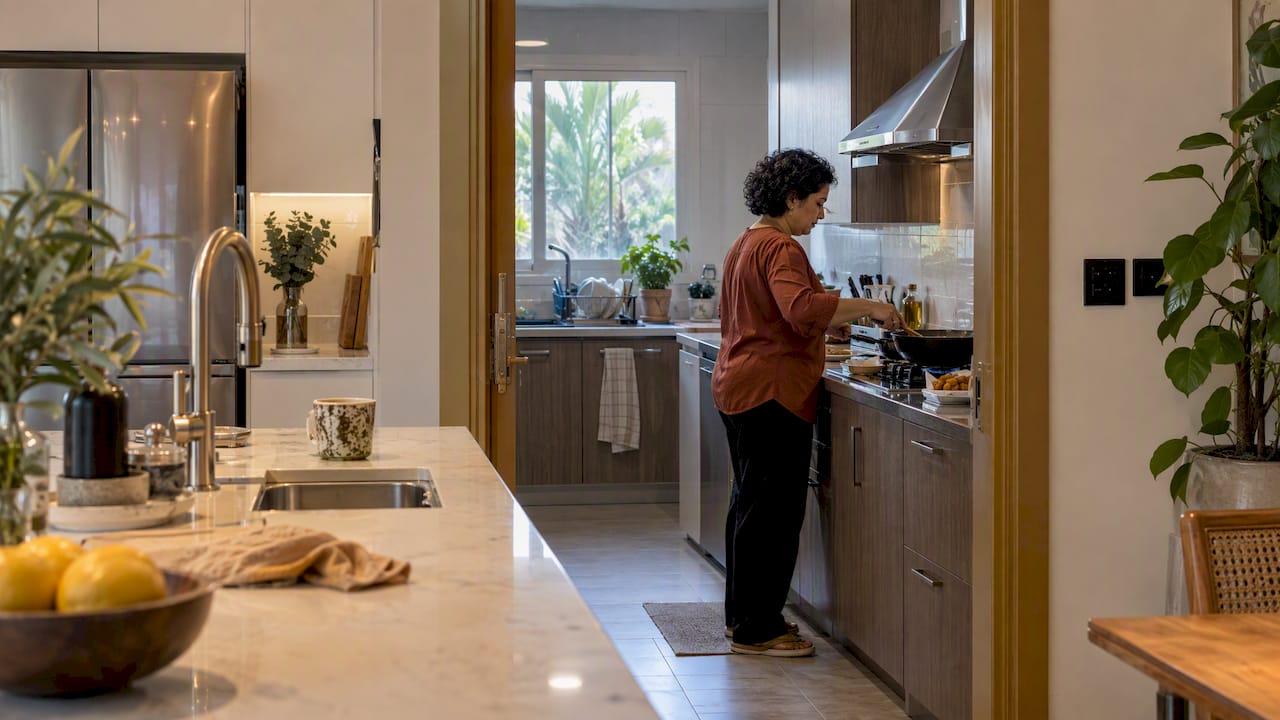
The hybrid costs more floor area and more fit-out, but it removes the compromise. Guests see a beautiful kitchen; the smoke stays behind a door.
When a flexible partition is enough
If there is no room for two kitchens, a movable divider can do much of the work. Homeowners in Dubai can install glass partitions or sliding doors so the kitchen is closed off while cooking, yet keeps sightlines and daylight when it is not in use. Glass is useful because it keeps the room bright; a well-fitted sliding door is useful because it actually blocks sound and smell.
Before altering an existing apartment, check the rules of your building. Changes that touch structure or ventilation usually need approval from the building management, so confirm the process before you plan works.
Ventilation: the detail that decides how it feels
An open kitchen with excellent extraction can outperform a closed kitchen with poor extraction. Here is what to look for.
- Ducted, not recirculating. Recirculating hoods pass air through a charcoal filter and return it to the room. They are much weaker than ducted systems and a poor choice for daily heavy-spice cooking.
- Enough airflow. For serious cooking, a ducted extractor should move 800 cubic metres per hour or more and be at least as wide as the hob.
- Make-up air. Extraction pulls air out, so air must come in. A sealed apartment with a powerful hood can struggle to extract properly.
- Moisture management. In Dubai homes, run the kitchen exhaust fan and, on cooler, drier days, open windows to flush out trapped moisture and reduce the risk of damp.
- Lighting that works. Good task lighting over worktops matters more than most buyers expect; it makes a closed kitchen feel larger and an open one safer to cook in.
How to choose: six questions
- What do you cook most days? Light meals favour open. Frying, grilling and spice-heavy dishes favour closed or hybrid.
- How often do you host? If dinner parties and family gatherings are regular, an open or semi-open layout gives the cook a place in the room.
- Who cooks? If someone else cooks for you, a separate working kitchen may suit both parties better.
- How large is the home? In a studio or one-bedroom, an open layout often saves the space. In a larger family home, a wall costs you little.
- What is the extraction like? Poor ducting argues for closing the kitchen. Strong, ducted extraction makes open planning far more comfortable.
- Who will buy or rent it next? Open and semi-open layouts tend to photograph well and feel contemporary; a hybrid broadens the appeal to cooks and hosts alike.
The homebuyer’s rule of thumb: decide by how you cook, how you entertain, how the home is cooled and ventilated, and how it will resell. A semi-open or dual kitchen suits heavy cooking and hosting together.
Our perspective
We design homes for people who live in them, and the kitchen is where that is tested hardest. Our view is simple: the layout should follow the life, not the brochure. Most of the buyers we speak with want a kitchen that looks effortless when guests arrive and works hard when no one is watching.
That is why we think of the kitchen as a system. The plan, the extraction, the finishes, the lighting and the smart-home controls all need to work together. A beautiful open kitchen with weak extraction is a disappointment within a month. A well-extracted, thoughtfully zoned kitchen, open or not, is something you stop noticing because it simply works.
Our advice to any buyer, ours or anyone else’s: ask to see the plan, ask where the air goes, and picture your busiest cooking day, not your best photograph. The right layout is the one that survives that test.
— Mark
Choosing a home with the right kitchen
If you are comparing new developments, make the kitchen part of your viewing checklist rather than an afterthought. Ask for the floor plan, the extraction route, the finishes specification and the options for the layout, then compare them against your answers to the six questions above.
We develop boutique luxury residences in Dubai and Ras Al Khaimah, with premium finishes, smart-home integration and wellness amenities, including Azure by Lapis and Lazord by Lapis. Each project page sets out the current details, and our team can walk you through the plans and answer your layout questions.
To explore the homes, view our current projects or start from our home page and enquire about a viewing. Bring your cooking habits with you: they are the best brief a developer can have.
Common mistakes to avoid
- Choosing for the photograph. A kitchen that looks stunning in a render may not suit daily frying.
- Ignoring extraction. Layout gets the attention; ducting does the work.
- Forgetting the cooling load. An open kitchen adds heat to the room you want to keep cool.
- Over-closing a small home. A full wall in a compact apartment can darken the whole space.
- Skipping the flexible option. A sliding glass door often delivers 80 per cent of the benefit of both layouts.
FAQ
Is an open kitchen a good idea for Indian or other aromatic cooking?
It can work for light cooking, but for daily tadka, frying or grilling a closed or back kitchen is usually better. A hybrid of an open show kitchen and a closed kitchen for heavy cooking is the common solution. If you choose a fully open plan, insist on a powerful ducted extractor.
Does an open kitchen make air conditioning bills higher?
It can. Cooking heat is released straight into the living space, so the air conditioning works harder to keep the room comfortable. A semi-open kitchen with a door or glass partition lets you contain that heat while you cook.
What is a semi-open kitchen?
It is a kitchen partly separated from the living area by a half wall, a pass-through, a glass screen or a sliding door. You keep the light and sightlines, and you can close it off for heavy cooking. For many UAE households it is the best balance.
Which kitchen layout is better for resale?
Open and semi-open layouts tend to appeal to buyers who want bright, connected living spaces, especially in apartments. A closed kitchen can still sell well in family homes, particularly when paired with strong extraction and good storage.
Sources
- Masonite: Open vs. Closed Kitchens
- NoBroker: Open Kitchen vs. Closed Kitchen
- Reedify: Open Kitchen Disadvantages
- Hausfits: Open vs Closed Kitchen Layouts for Dubai Homes
- Kat Black: Open Plan vs Closed Plan, Dubai Hills Villa Layouts
- Dubai Local Order No. (11) of 2003 Concerning Public Health
- Emaar MEP Design Guidelines, Rev 6, December 2023
- Renovel: Kitchen Design Dubai
- Geem: How to Prevent Damp and Mould in Dubai Homes