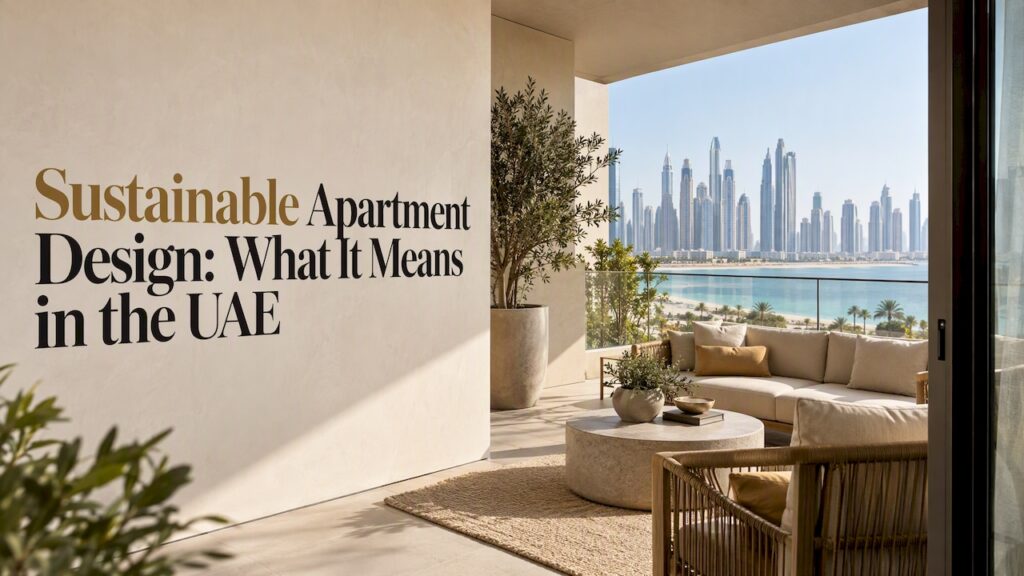
Sustainable apartment design is the practice of planning a building so that it uses less energy and water, wastes less material, and stays comfortable and healthy for the people who live in it, from construction through to the end of its life. In the UAE, that starts with the sun: orientation, shading, a high-performance envelope and well-planned outdoor space matter more than any single gadget. This guide explains the principles, the local rules, the community-scale features that make a development work, and how to test a developer’s sustainability claims before you buy.
TL;DR
- Sustainable apartment design looks at the whole life of a building, not only the energy bill: materials, water, waste, health and comfort all count.
- In the UAE’s climate, the biggest gains come from orientation, shading, the building envelope, efficient cooling and smart use of landscape.
- Dubai, Abu Dhabi and Ras Al Khaimah each have their own green-building framework, so ask which one a project is built to.
- A green community is more than one efficient tower: parks, walkable routes, shade, water and waste planning shape daily life.
- Before buying, ask for named standards, drawings and specifications rather than accepting the word “sustainable”.
Table of Contents
- What sustainable apartment design actually means
- The core principles, applied to a UAE apartment
- The rules that apply in Dubai, Abu Dhabi and Ras Al Khaimah
- From one building to a green community
- Our perspective
- How to check whether a project is genuinely sustainable
- Sustainable design, applied at Lapis Properties
- Frequently asked questions
- Sources
What sustainable apartment design actually means
Researchers at Australia’s housing research institute describe a sustainable apartment as a dwelling that gives residents comfort and lower utility costs while minimising consumption and waste and maximising energy efficiency across construction and the full lifecycle. Two ideas in that definition are worth keeping.
The first is lifecycle thinking. A building that is cheap to cool but made from materials that need replacing every few years is not sustainable. A building that is beautiful but costs a fortune to run is not either.
The second is comfort. If residents are too hot, too dark or breathing stale air, they will compensate with more air conditioning and the design fails on its own terms. Finishes matter here too: the same logic that applies to sustainable kitchen design, durable, well-made materials chosen for the long term, applies to every room in an apartment.
Sustainability is wider than energy
Abu Dhabi’s Estidama framework presents sustainability as a balance of four pillars: environmental, economic, cultural and social. Its categories run from integrated process and natural systems to livability, water, energy, materials and innovation, as set out in the Estidama Pearl Rating System manual. Dubai’s legal structure is similarly broad. Its green building bylaw reaches beyond operational energy to water, materials, health, safety, site selection, maintenance, demolition and recycling.
The practical lesson: when a brochure says “energy-efficient” and stops there, you have heard one fifth of the story.
The core principles, applied to a UAE apartment
The principles are consistent across frameworks: lifecycle thinking, comfort and wellbeing, lower energy and water demand, efficient systems, responsible materials, renewable energy where it makes sense, and an integrated design process where architects, engineers and landscape designers work together from the start. Here is what each looks like in a hot, sunny, coastal climate.
Orientation, massing and shading
The cheapest kilowatt is the one you never need. Positioning a building and shaping its volume to limit direct solar gain, then adding effective shading over glazing, reduces the cooling load before a single machine is specified. The Estidama manual points to the same sequence: climate-responsive design first, systems second. Deep balconies, fins, recessed windows and covered terraces do real work here, and they also create the outdoor rooms that people in the Gulf use for much of the year.
The envelope
Glazing specification, wall insulation and airtightness decide how hard the cooling plant works. Large views are a selling point for any sea-facing apartment, so the question is how the glass performs: its coating, its frame, and how much of it faces the afternoon sun.
Daylight and ventilation
Good daylight cuts lighting demand and improves wellbeing. Controlled ventilation, with fresh air brought in without dumping heat, keeps air quality healthy. Layouts that let daylight reach deep into living areas, with shaded openings rather than bare glass, achieve both.
Efficient systems and smart controls
High-efficiency cooling, LED lighting and efficient appliances are the baseline. Smart-home integration can help when it does something measurable: zoned cooling, occupancy-based lighting, and clear consumption feedback. It does not replace good design. Researchers studying sustainable neighbourhoods also stress that technology has to be accompanied by behaviour and lifestyle change, so the best systems make the efficient choice the easy one.
Water
Water-efficient fixtures, drought-tolerant planting and efficient irrigation cut demand in a country where much of the supply is energy-intensive to produce. Abu Dhabi describes its Al Fay Park on Reem Island as a 27,500-square-metre park with 2,000 local flora species and irrigation using 40% less water than traditional gardens, a useful reference point for what landscape design can achieve.
Materials and waste
Specifying durable, low-impact materials, planning construction waste, and designing for maintenance all count. Estidama’s Stewarding Materials category and Dubai’s coverage of materials and waste show that regulators treat this as a core requirement, not an extra.
Renewable energy
Rooftop solar suits many buildings, though a tall apartment block has limited roof area per resident, so it often supports common areas rather than every unit. At grid level, the Abu Dhabi government reports that EWEC met 80% of total power demand, stated as 7.7 GW, through solar and nuclear in March 2023, which shows how much of an apartment’s footprint depends on the supply behind the socket as well as on the building itself.
The rules that apply in Dubai, Abu Dhabi and Ras Al Khaimah
There is no single UAE-wide green label for homes. The framework depends on the emirate, and that is the first thing to check about any project.
| Emirate | Framework | What to know |
|---|---|---|
| Dubai | Dubai Building Code and Al Sa’fat Green Building System | Al Sa’fat (2nd edition, January 2023) is organised around ecology and planning, building vitality, energy efficiency, water resource effectiveness, and materials and waste. Silver Sa’fa is mandatory for all buildings; Gold and Platinum are optional, as the 2020 administrative resolution sets out. |
| Abu Dhabi | Estidama Pearl Rating System | Pearl ratings assess projects across integrated process, natural systems, livability, water, energy, materials and innovation. |
| Ras Al Khaimah | Barjeel Green Building Regulations | Draft Version 1.3 aims to conserve energy and water, implement renewables, promote sustainable materials and reduce waste, and it applies throughout the emirate. |
Two points follow from this table. First, since Silver is mandatory in Dubai, “meets Dubai green building requirements” is a baseline, not a differentiator. The Dubai Building Code itself says its requirements are minimums that do not prevent higher-performing designs. What matters is what a developer does beyond the floor.
Second, rules evolve. Barjeel’s Version 1.3 is a draft in the source above, so if you are buying in Ras Al Khaimah, ask the developer which version of the regulations the project follows, and check the municipality’s site for the current status.
From one building to a green community
An efficient tower in a hot, treeless, car-dependent district still delivers a hot, car-dependent life. That is why readers who search for green community design are really asking about the neighbourhood around the building.
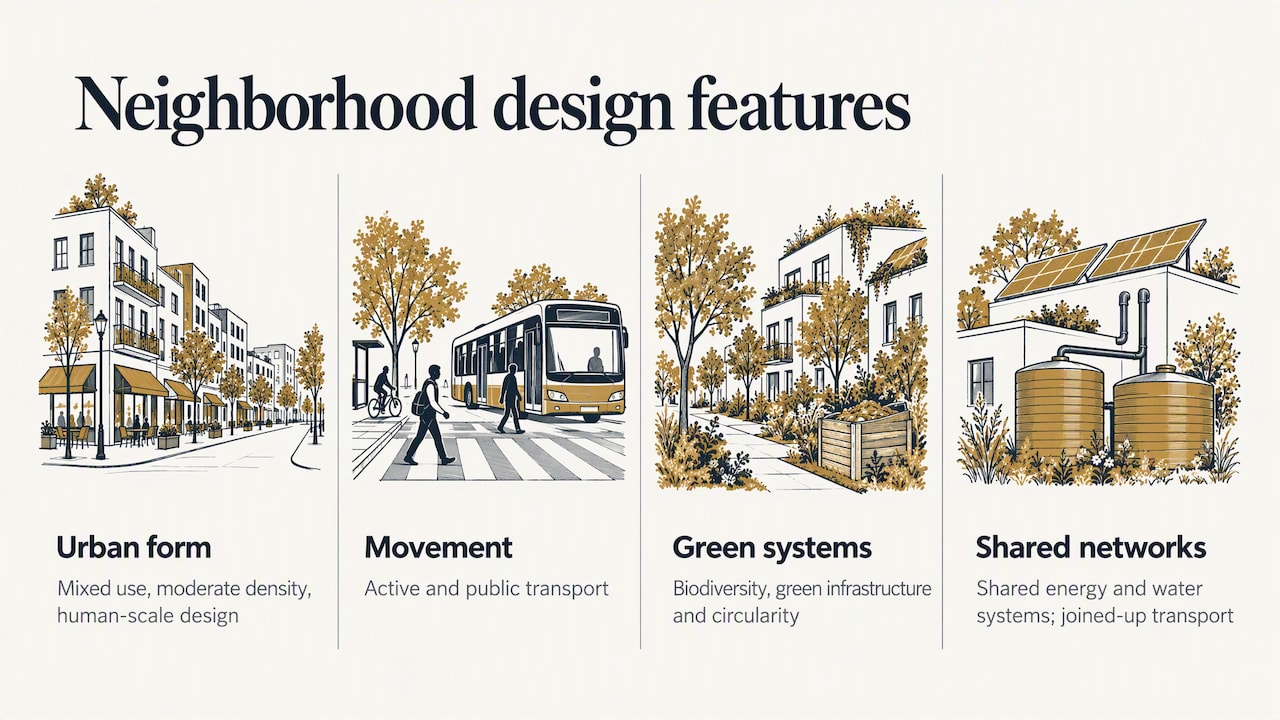
UNEP’s neighbourhood guidance says layout decisions on location, movement, connections, orientation and biodiversity can influence microclimate, minimise energy use and support renewable energy, and it calls for integrated water and waste planning alongside community engagement. Neighbourhood-scale research adds that this scale sits between the building and the city, which allows shared energy and water systems, joined-up transport planning, biodiversity and social sustainability. The same research lists mixed use, moderate density, human-scale design, active and public transport, green infrastructure and circularity as traits of sustainable neighbourhoods.
Features that residents notice
- Shade you can walk in. Tree-lined, shaded routes make short trips on foot realistic for more months of the year.
- Green space with a purpose. Planting that cools the microclimate and supports local species does more than decorative lawn.
- Cycling and outdoor routes. Abu Dhabi’s For Abu Dhabi programme reported 16 community parks redeveloped and 200 km of cycle paths added, tying sustainability to everyday outdoor life.
- Shared amenities. Fitness and wellness spaces, community lounges and landscaped courtyards reduce the need to travel and give neighbours places to meet.
- Human scale. Boutique buildings with a limited number of homes feel quieter and are easier to manage well than very large towers.
None of this is decoration. Social sustainability, the sense that people know their neighbours and want to stay, is one of the four pillars in the Estidama approach and one of the strongest predictors of a community that holds its value.
Our perspective
We build boutique residential projects in Dubai and Ras Al Khaimah, and the way we think about sustainable apartment design comes down to a few convictions.
Scale is a sustainability tool. Boutique buildings let us give attention to detail that large, repetitive towers cannot: how each apartment is oriented, how the shared spaces are used, how finishes age. Fewer homes also means a stronger sense of community, which is the part of sustainability that spreadsheets miss.
Luxury and responsibility are not opposites. Private plunge pools, smart-home integration, premium finishes and wellness amenities sit comfortably beside responsible design when they are planned together rather than added afterwards. A well-shaded terrace, a controlled interior and durable materials make a home feel premium and cost less to live in.
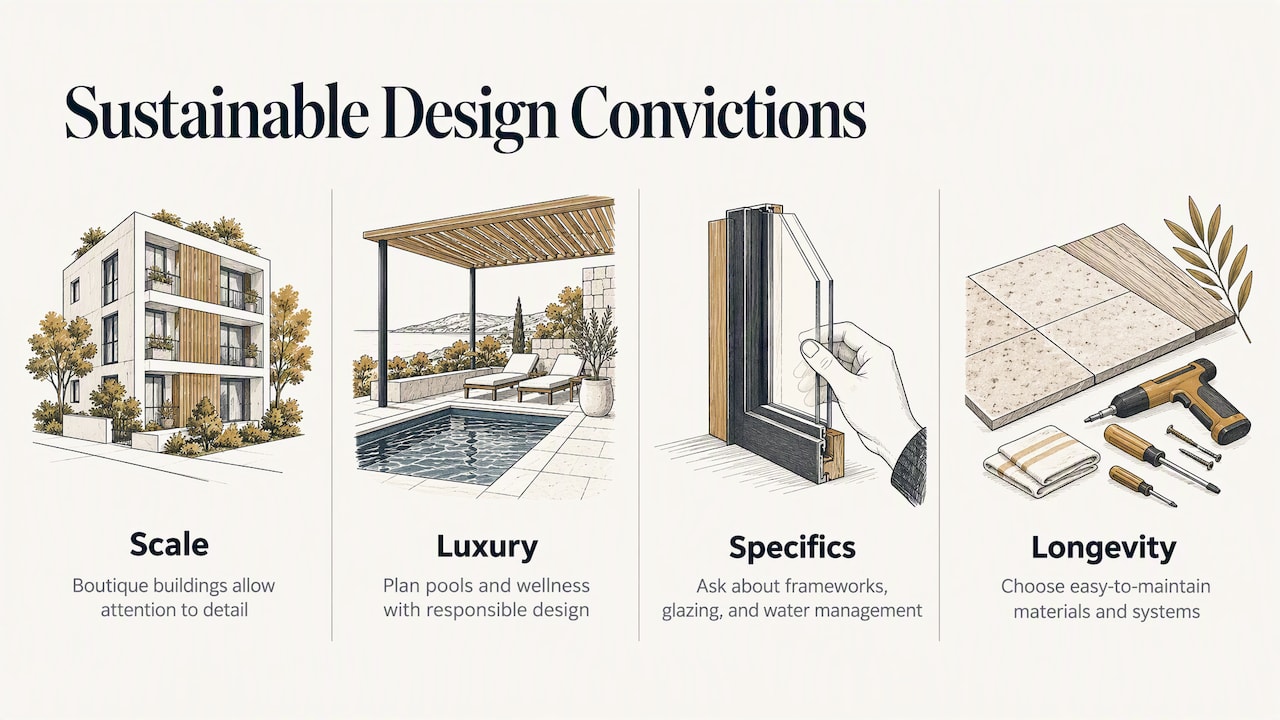
Judge a developer on specifics. We would rather you asked us hard questions. Which framework does the project follow? What is the glazing specification? How is water managed? A developer who is proud of the design will answer in detail.
Design for a life, not a launch. We think about the people who will live in a building in ten years, which is why we favour materials and systems that are easy to maintain and communities that give residents reasons to stay.
— Mark
How to check whether a project is genuinely sustainable
Marketing language is cheap, so use a short checklist. It works for any developer, including us.
- Ask which standard applies. In Dubai, confirm the Al Sa’fat classification the project is designed to; in Abu Dhabi, the Estidama Pearl target; in Ras Al Khaimah, how the project follows the Barjeel regulations.
- Separate the baseline from the extras. Since Silver is mandatory in Dubai, ask what the project does beyond it, and get that in writing.
- Request the specifications. Glazing performance, shading design, cooling system type, and water fixtures should be in the unit specification, not only the brochure.
- Look at the orientation and the balcony. Check how your own unit faces the sun and whether the outdoor space is shaded.
- Ask about water and waste. Irrigation approach, landscape planting and construction waste planning show whether sustainability was designed in or added on.
- Walk the neighbourhood. Shade, paths, parks and everyday services within reach tell you more than renderings do.
- Plan the running costs. Ask for an estimate of service charges and typical cooling costs for a unit of your size, and compare projects on that basis.
- Check the track record. Look at construction updates and completed work, not only launches.
If an answer is vague, that is information.
Sustainable design, applied at Lapis Properties
At Lapis, we design luxury apartments around sustainable practices, boutique scale and lifestyle features such as private plunge pools, smart-home integration, wellness and fitness amenities, and community spaces. You can explore our current launches on the Azure by Lapis and Lazord by Lapis pages, where both projects are listed with starting prices. For a closer look at how a project takes shape, our construction updates show progress on site, and our project archive lets you compare what is on offer. If you are weighing a purchase as an investment, our guide to your next profitable investment in the UAE sets out how we think about lasting value.
Frequently asked questions
What are the main principles of sustainable design for apartments?
The core principles are lifecycle thinking, comfort and wellbeing, lower energy and water demand, efficient systems, responsible materials and waste planning, renewable energy where appropriate, and an integrated design team. Frameworks such as Estidama group these into categories like water, energy, materials and livability. In a hot climate, orientation and shading come first.
Are eco-friendly apartments more expensive to run or to buy?
They are designed to cost less to run, because lower cooling and water demand reduces utility bills over time, which is the logic behind the lifecycle definition used by housing researchers. Purchase prices depend on the location, size and specification of the project, so compare running costs and service charges alongside the price. Ask the developer for specifics on both.
Is green building mandatory in the UAE?
It depends on the emirate. In Dubai, Silver Sa’fa is mandatory for all buildings under the 2020 administrative resolution, while Gold and Platinum are optional. Abu Dhabi applies Estidama, and Ras Al Khaimah has its Barjeel Green Building Regulations, with Version 1.3 published as a draft. Check the current status with the relevant authority.
What makes a community green rather than just a building?
A green community plans the space between buildings: shade, parks, walkable and cycling routes, water and waste systems, and places for neighbours to meet. UNEP’s guidance links these layout decisions to microclimate, energy use and community engagement. The building is one part of a larger system.
Sources
- UNEP: The new neighbourhood, creating new community around sustainability
- AHURI: Delivering sustainable apartment housing
- AHURI: Sustainable housing at a neighbourhood scale
- Estidama Pearl Rating System manual
- Dubai Administrative Resolution No. 154 of 2020 on the green building bylaw
- Al Sa’fat Dubai Green Building System, 2nd edition
- Dubai Building Code, 2021 edition
- Ras Al Khaimah Barjeel Green Building Regulations, Version 1.3
- Government of Abu Dhabi: Climate Change Strategy
- Government of Abu Dhabi: Living in Abu Dhabi
- For Abu Dhabi impact report
- Sustainable kitchen design