A title deed is the Dubai Land Department (DLD) document that records you as the legal owner of a property. The issuing fee is AED 250. The bigger cost is the 4% transfer fee on a resale, normally split between buyer and seller. If you buy off-plan, you hold an Oqood first and receive the title deed only after the project is complete and the unit is fully paid. This guide explains each step in that order, with the official figures.
TL;DR
- The title deed proves ownership. A signed contract or a deposit does not make you the registered owner, so the registration step matters.
- Official fees: AED 250 for the title deed certificate, plus 2% of the sale value each for buyer and seller on a sale registration.
- Off-plan buyers receive an Oqood (initial registration) first. The title deed follows after completion and full payment.
- Anyone can check a deed with the DLD’s online verification service, using the deed number, year and property type.
- Before you pay a deposit on any unit, ask what the registration and handover timeline is, in writing.
Table of Contents
- What a Dubai title deed is and what it proves
- Title deed or Oqood: which document do you hold?
- How much does a Dubai title deed cost?
- How to get your title deed: the steps
- How to verify a title deed online
- Common questions about timing and mistakes
- Our perspective: plan for the deed on day one
- Buying off-plan with Lapis Properties
- FAQ
- Sources
What a Dubai title deed is and what it proves
The title deed is issued by the Dubai Land Department from its property register. It is the record that says who owns a specific unit, plot or building. The DLD manages land title registration in Dubai to protect ownership and prevent disputes.
For foreign buyers, the key point is the kind of right you hold. Freehold is absolute ownership that is not restricted in time. That is different from usufruct, musataha and leasehold rights, which are limited in scope or duration. When you read a deed, check which of these applies to your unit and that it matches your sales contract.
The practical consequence is simple. Until the transfer is entered in the register, you are a buyer with contractual rights, not the registered owner. That is why the registration step, and who handles it, deserves as much attention as the price.
Title deed or Oqood: which document do you hold?
This is the most common confusion, and the answer depends on whether the property is finished.
| Oqood | Title deed | |
|---|---|---|
| Applies to | Off-plan and under-construction units | Completed, registered units |
| Who registers it | The developer, on the initial register, then the buyer is recorded | The DLD, after sale registration or completion |
| When you receive it | After the sales contract is signed | After completion, once the unit is fully paid |
| What it shows | Your contractual interest in a unit that is not yet built | Registered legal ownership |
When the project is finished, parties who have met their contractual obligations can request a Certificate of Title or title deed through the Oqood portal, using the service for completing the initial procedures. In practice, that means two things for you: keep your payment plan up to date, and keep every receipt, because the deed depends on the unit being fully paid.
So the two documents are not the same. The Oqood is the starting record of an off-plan purchase. The title deed is the end result.
How much does a Dubai title deed cost?
There are two separate sets of figures, and readers often mix them up: the cost of the deed itself, and the cost of transferring the property.
The deed itself
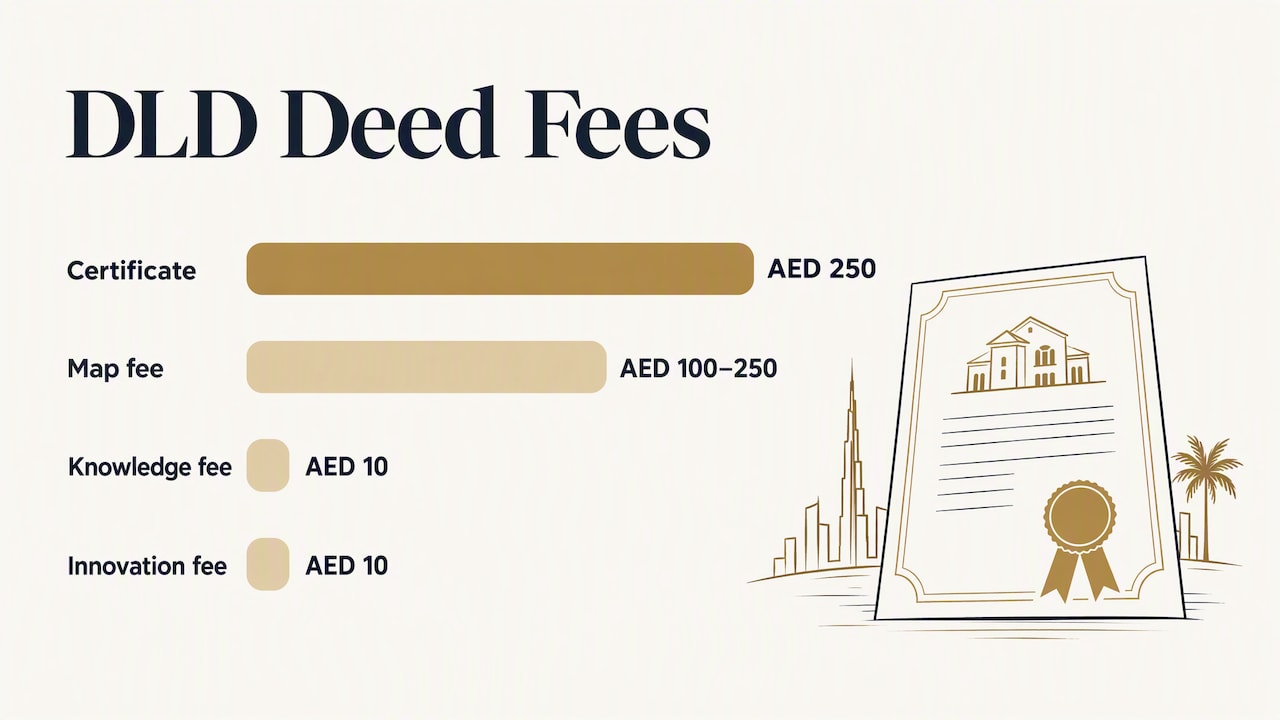
The DLD lists AED 250 for the title deed certificate. Additional charges typically apply for maps, from AED 100 to AED 250 depending on the type, plus a knowledge fee and an innovation fee, usually AED 10 each. The amounts for your case appear on the DLD page when you register.
The transfer fee
On a sale, the transfer fee is 4% of the sale value, typically split equally: 2% for the buyer and 2% for the seller, paid to the DLD at the time of the transaction.
Here is a worked example using only those official figures. Take a resale at AED 1,000,000:
| Item | Amount |
|---|---|
| Buyer’s 2% | AED 20,000 |
| Seller’s 2% | AED 20,000 |
| Title deed certificate | AED 250 |
| Map, knowledge and innovation fees | Vary, see the DLD page |
The split is the usual arrangement, not a legal certainty, so confirm in your sale agreement who pays what before you sign. Trustee-centre and agent charges are separate and quoted by those providers.
On a new purchase, the same registration costs apply in principle, and who bears them depends on your sales contract with the developer. Ask for a written list of every fee between signing and handover.
How to get your title deed: the steps
For a resale (ready property)
- Agree the sale. Buyer and seller sign the sale agreement and settle any mortgage on the unit.
- Go to a registration trustee centre. The DLD process is to register the sale through a Real Estate Registration Trustee centre: documents are submitted and verified, the transaction is entered and audited, then fees are paid.
- Bring the right documents. For individuals, that means both parties’ Emirates IDs, or a valid passport for non-resident foreigners. In freehold areas, a developer e-NOC is also needed.
- Pay the fees. Transfer fee, title deed fee and the extras above.
- Receive the new deed. The deed is issued in the buyer’s name, and you can verify it online.
A separate DLD service handles title transfers applied for at the customer happiness centre, which requires a letter from the transferor and the owner’s identity documents. Which route applies depends on the type of transfer, so confirm with the DLD or your trustee centre first.
For an off-plan purchase
- Sign the sales contract and pay the initial instalment.
- The developer registers your purchase on the initial register (the Oqood).
- Follow the payment plan through construction.
- After completion and full payment, request the Certificate of Title or title deed through the Oqood portal service, or ask your developer how they coordinate this.
- Verify the issued deed using the steps below.
How to verify a title deed online
The DLD’s Verify Title Deed service lets you validate a deed using its number, year and property type. You can run this check on your own deed, and on a deed a seller shows you before you pay anything.
A few practical points:
- Read the status. Results may show statuses such as Valid, Mortgaged, Restrained, Blocked or Invalid. Anything other than Valid needs an explanation before you proceed.
- Check the paper copy. Paper deeds should carry the DLD stamp and QR code, and the DLD app can be used to compare the deed against the contract details.
- Know the limits. The DLD property register is private, so a third party needs the owner’s no-objection certificate to get independent confirmation of ownership. Because of this, due diligence is limited, and buyers increasingly request lawyer-prepared due diligence reports and professional valuation surveys.
For a high-value purchase, treat verification as the minimum, not the full check. A property lawyer can confirm mortgages, restrictions and the consistency of the seller’s documents.
Common questions about timing and mistakes
“I paid a deposit, am I the owner?” Not yet. Ownership is registered through the DLD process above. Keep the deposit receipt and make sure the contract names the registration steps.
“Can I get a digital copy?” Yes, the DLD verification service and app let you check the deed electronically. The paper certificate remains the stamped document to keep safe.
“What if the unit has a mortgage?” The deed will show a Mortgaged status until the lender’s interest is released. If you are buying a resale, agree in the contract how the existing mortgage will be settled and by whom.
Mistakes we see buyers make:
- Treating the sales contract as proof of ownership.
- Assuming the 4% transfer fee is always charged in full to the buyer.
- Not keeping payment receipts when the deed depends on a fully paid unit.
- Skipping verification of a deed because an agent says it is fine.
Our perspective: plan for the deed on day one
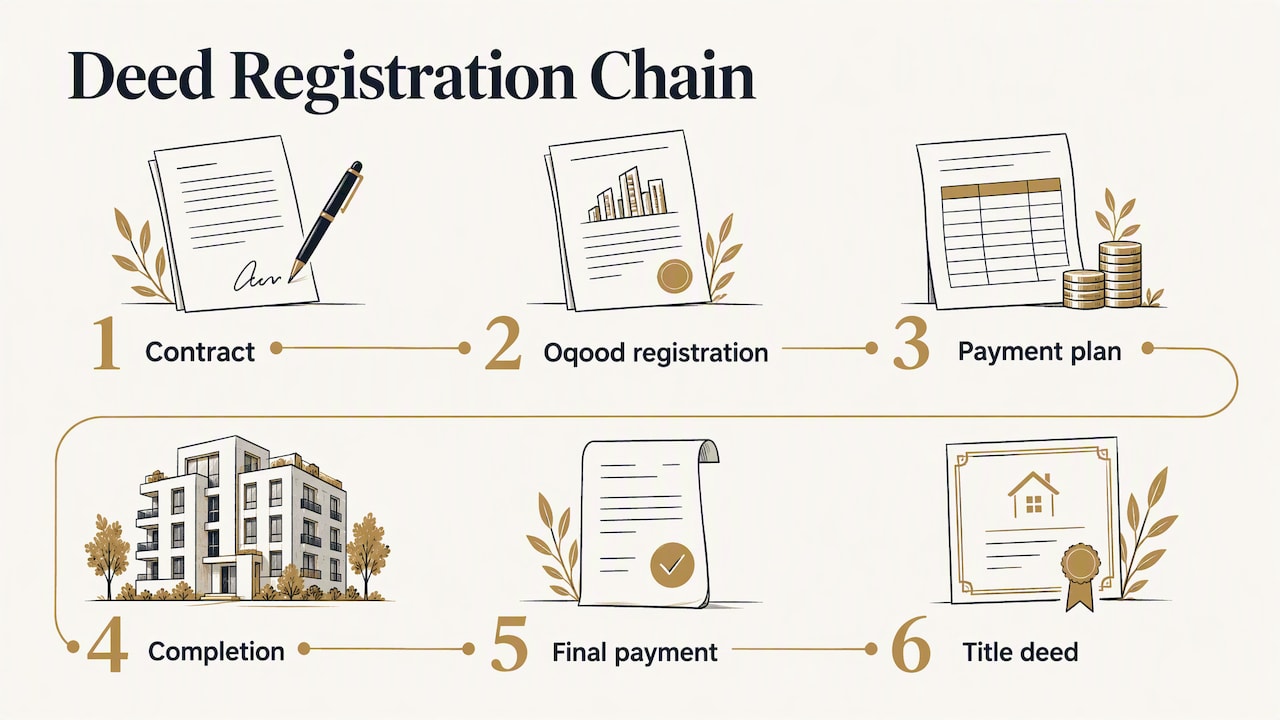
We develop boutique residential projects, and our view is that the title deed should be part of the conversation before you reserve a unit, not something you chase at handover. A deed is the end of a chain: contract, Oqood registration, payment plan, completion, final payment, deed. Each link should be explained to you in plain words.
For buyers, we suggest three habits. First, ask for the full list of fees from signing to deed, including the DLD registration costs, so the budget you set is the budget you spend. Second, keep a single folder with the contract, receipts and registration confirmations, because the deed request depends on a clean record. Third, verify the deed yourself on the DLD service when it is issued, even if everyone involved is reputable. It takes minutes.
For investors, the same discipline protects resale value. A buyer’s lawyer will ask for the deed status, and a clean, verified record speeds up a sale. We would rather you arrive at handover informed than surprised, and our team is glad to walk you through the registration process for any unit you are considering.
— Mark
Buying off-plan with Lapis Properties
If you are weighing a new-build purchase, our current developments are Lazord by Lapis, with apartments from AED 750,000, and Azure by Lapis, from AED 790,000. Both are off-plan, so the Oqood-to-title-deed path above applies. You can read about Lazord’s Majan location on its project page in Dubailand, follow its construction updates to see how far the build has progressed, or get in touch through our site to ask about the registration and handover timeline for a specific unit.
FAQ
How do I get my title deed in Dubai?
For a resale, register the sale through a Real Estate Registration Trustee centre, pay the fees and receive the deed in the buyer’s name. For an off-plan unit, the deed is issued after completion and full payment, and you can request it through the Oqood portal service. Ask your developer how they handle this at handover.
Can I download my title deed online?
You can check a deed online with the DLD’s Verify Title Deed service, using the deed number, year and property type. This confirms the record and its status. The stamped paper certificate, with its QR code, remains the document to keep.
How much does it cost to get a title deed in Dubai?
The DLD lists AED 250 for the title deed certificate. Map charges (AED 100 to AED 250) and knowledge and innovation fees (usually AED 10 each) can be added. On a sale, the 4% transfer fee is typically split 2% each between buyer and seller.
Is Oqood the same as a title deed?
No. The Oqood is the initial registration of an off-plan purchase, made by the developer, and you do not receive a title deed at that stage. The title deed is issued after project completion for units that are fully paid.
Sources
- Dubai Land Department: Property Sale Registration
- Dubai Land Department: Title transfer application
- Dubai Land Department: Verify Title Deed
- Dubai Land Department: Request to complete the initial procedures
- Dubai Government: Land Title Registration
- DLA Piper: Registration of title in the UAE (Dubai)
- Benhams: Title deed verification in Dubai