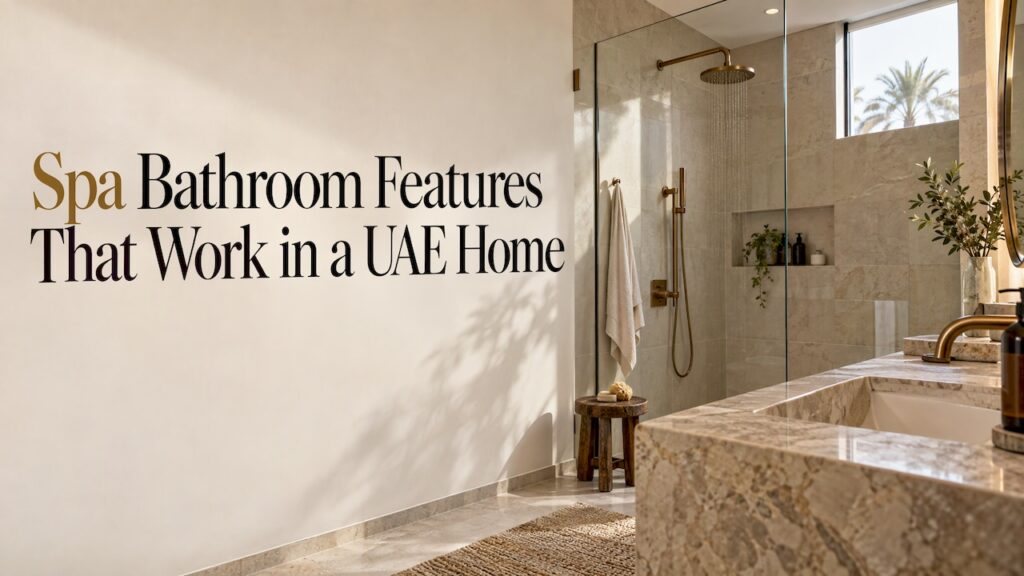
A spa bathroom comes down to a handful of features done properly: a walk-in shower with a rain head, a steam shower or a bath you can soak in, layered dimmable lighting, calm natural materials, hidden storage and, above all, waterproofing and ventilation that suit the UAE climate. This guide shows which features earn their place, how to choose between a steam shower and a sauna, and whether a freestanding or built-in bath suits your room.
TL;DR
- The feature Dubai designers report as most requested is a walk-in steam shower with a ceiling-flush rain head, usually paired with a hand-held shower.
- Choose a steam shower if you want a daily ritual in a compact footprint. Choose a sauna if you have a spare room and want dry heat.
- A freestanding bath needs far more floor space than a built-in one. In a smaller bathroom, a generous walk-in shower is the better use of the room.
- Layered lighting, soft natural materials and concealed storage create the calm. Tanking and ventilation keep it that way.
- Water-efficient fittings are part of modern spa design and are increasingly required in new UAE buildings.
Table of Contents
- What makes a bathroom feel like a spa
- The shower: walk-in, wet room, rain head and hand-held
- Steam shower or sauna: choosing your heat
- Freestanding bath or built-in bath
- Lighting, colour and materials
- Storage: hide the technology, hide the clutter
- Waterproofing and ventilation: the unseen spa features
- Water and energy efficiency
- Our perspective
- Find a home designed for wellness
- FAQ
- Sources
What makes a bathroom feel like a spa
A spa feels calm because nothing competes for your attention. Warm light, a soft palette, one or two tactile materials, and fittings that do their job quietly. The feature list below follows that logic: start with water, add warmth, then control light, surfaces and clutter.
In the UAE there is a second layer. Many residents have stayed in wellness hotels and want the same experience at home, which is why Dubai design studios describe the steam shower with a rain head as the single most requested feature in their briefs. Another studio describes the dominant 2026 look as a spa-style master bathroom: a large walk-in rain shower, a double floating vanity, large-format marble or marble-effect tiles, backlit mirrors and dimmable layered lighting.
The luxury features that appear most often in Dubai master bathrooms are:
- A walk-in shower with frameless glass and a rain showerhead
- A steam shower
- A freestanding bathtub
- A double vanity
- Heated flooring
- A smart mirror
- Custom storage
- Accent lighting
That list comes from a 2026 Dubai design guide. You rarely need all of them. Pick by room size and how you actually bathe.
The shower: walk-in, wet room, rain head and hand-held
The shower is the centrepiece of most UAE spa bathrooms, because most homes, apartments especially, are built around showering rather than bathing.
Walk-in shower or wet room
A wet room is fully waterproofed, so water falls directly onto the floor rather than into a tray. According to a wet room guide, there are three main types:
- A fully tanked wet room, with the whole room waterproofed.
- A wet room-style shower area, with one designated waterproofed zone.
- A traditional walk-in shower with a fixed glass panel.
For an apartment bathroom, the third option, or a designated waterproofed zone, is usually the most practical. A fully tanked room suits larger master bathrooms where you want one continuous floor.
Rain head, hand-held and side jets
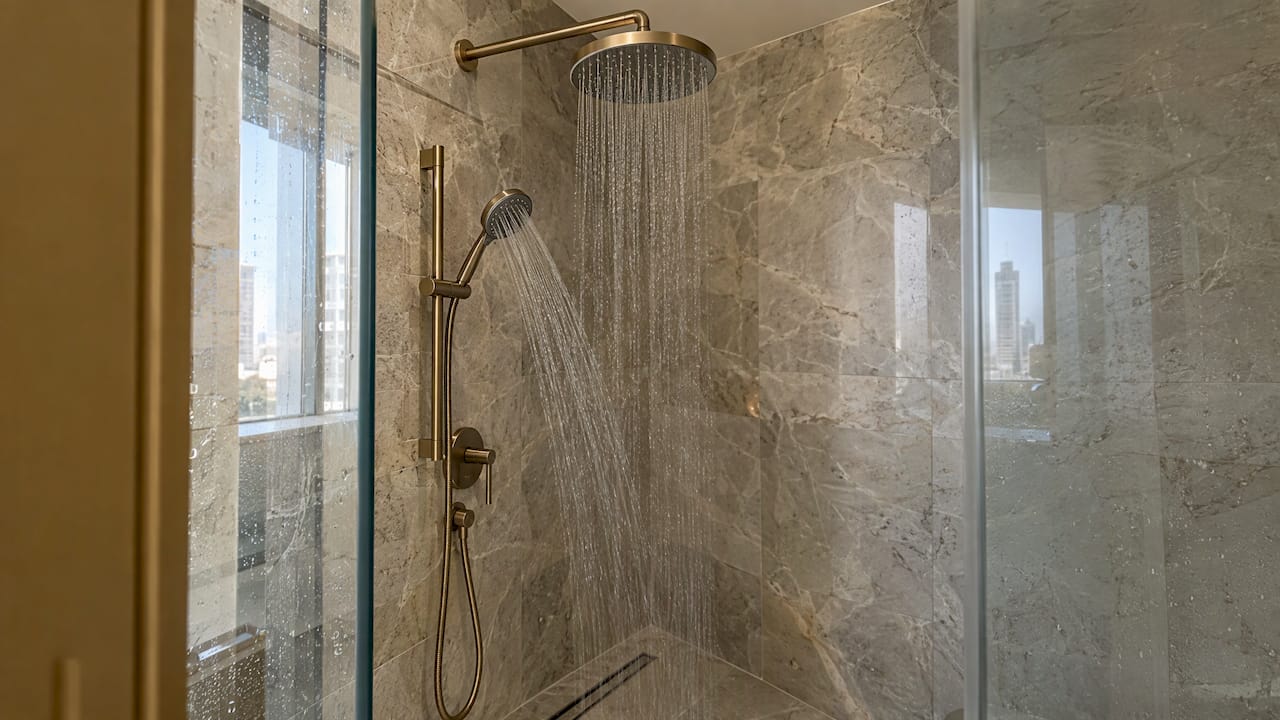
Rain heads have grown from 30 cm round heads to 60 cm and 80 cm rectangular ceiling panels. Designers pair them with a hand-held shower, which makes cleaning the enclosure and rinsing easier, and in larger bathrooms add side jets.
Three practical points:
- Height. One manufacturer guide suggests placing rain heads 85 to 90 inches from the floor for full-body coverage. That is roughly 216 to 229 cm, so it suits a high ceiling. Check your ceiling height before choosing a drop-down arm or a flush panel.
- Dual heads. The same guide notes that a dual-head unit needs a centre wall so the hand-held shower sits in a comfortable position.
- Finish. In humid or coastal UAE conditions, the guide says corrosion-resistant materials such as brass and stainless steel matter for long-term performance.
Higher ceilings help here. If you are comparing homes, our guide to high-ceiling apartments in the UAE explains what to look for.
Steam shower or sauna: choosing your heat
Both deliver warmth and relaxation, but they are different rooms with different requirements.
| Steam shower | Traditional sauna | |
|---|---|---|
| Temperature | About 110 to 120°F (43 to 49°C) | About 150 to 195°F (66 to 91°C) |
| Humidity | Close to 100% | Typically 5 to 20% |
| Minimum footprint | Sealed enclosure of at least 3 x 3 ft | Room of at least 4 x 4 ft |
| Plumbing | Water supply and drain | No plumbing rough-in |
| Power | Dedicated 240V circuit | Electric or wood-burning heater |
| Typical retrofit | Converts an existing shower | Needs a separate space |
The figures come from a contractor buying guide, which also notes that a steam enclosure needs a sloped ceiling so condensation does not drip on you, and that hard-water mineral scale is a leading cause of generator failure. Dubai water is hard, so ask about a scale-resistant generator or a water softener when you plan.
Which should you choose?
Choose steam if you have a standard bathroom and want a spa ritual that fits in the shower footprint. Because a steam room needs a drain, most home retrofits replace an existing shower with a steam shower, with the generator housed nearby in a closet or cabinet.
Choose a sauna if you have a spare room or a villa wellness corner. The same source says a traditional sauna is quicker and less complicated to install. A Dubai fit-out firm points out that sauna design here involves premium timbers such as cedar, digital temperature control and humidity-managing ventilation, and that saunas are energy-intensive, so efficient heating systems are worth specifying.
For most apartment owners, steam is the more realistic choice. Smart controls, such as app-controlled heating and automated aromatherapy, are part of the growing wellness suite trend if you want to go further.
Freestanding bath or built-in bath
A freestanding bath is a statement. A built-in bath is a space-saver. The right answer depends mostly on floor area.
| Freestanding | Built-in | |
|---|---|---|
| Clearance | About 1100 mm at the foot and at least 600 mm each long side | Suits rooms of about 4 to 5 sqm |
| Sensible minimum room | About 7 sqm | Smaller rooms work |
| Cleaning | Six accessible surfaces, including underneath | One silicone seam, resealed every 5 to 7 years |
| Plumbing | Typically through the floor | From the side or end of the alcove |
The space and cleaning figures come from a UK bathroom retailer’s comparison. A manufacturer comparison gives a slightly more compact guide: at least 55 cm all round for a freestanding tub, and 175 by 75 cm plus 50 cm of clearance on the long side for a conventional built-in tub in a corner.
Two more differences are worth knowing:
- Access. A freestanding tub can be reached from all sides, which makes it easier to help someone with a physical impairment. A built-in tub is usually accessed from one long side only.
- Installation. A freestanding tub arrives finished and is positioned and connected to plumbing, while a built-in tub involves framing, tiling and waterproofing and takes longer.
In large villa master bathrooms of 12 sqm or more, one Dubai guide says the strongest specification pairs a walk-in rain shower with a freestanding bath. For apartments and standard bathrooms, it recommends a walk-in shower alone. That is sensible advice: a bath that crowds the room spoils the calm you are trying to create.
Lighting, colour and materials
Lighting does more for atmosphere than any fixture. One Dubai studio recommends three layers: task lighting at the mirror, ambient light such as concealed strips under a bath plinth or in niches, and a decorative pendant over the vanity. Put them on dimmers and the same room works as a bright morning space and a candlelit evening one.
For colour and texture, the palettes designers suggest are soft whites and creams, earthy greens and browns, and cool greys and muted blues. Natural materials include marble, limestone or travertine, wood accents such as teak, cedar or bamboo, and soft cotton, linen and woven textiles. The same guide suggests plants such as ferns, palms, aloe vera and orchids, and warm LED strips instead of harsh overhead light.
A few additions that suit the UAE climate:
- Backlit mirrors with a demister. They are now expected in any renovation above basic level, because they prevent fogging in humid conditions.
- Porcelain over natural stone in wet zones. Porcelain tiles with water absorption below 0.5% are described as the most reliable choice for shower floors, steam rooms and wet rooms. Travertine needs filling, sealing and annual resealing, and in steam showers a porcelain tile that replicates its look is recommended.
- Large-format tiles. Fewer grout lines mean less to clean, and wall-mounted toilets and recessed niches make the room easier to keep tidy.
Storage: hide the technology, hide the clutter
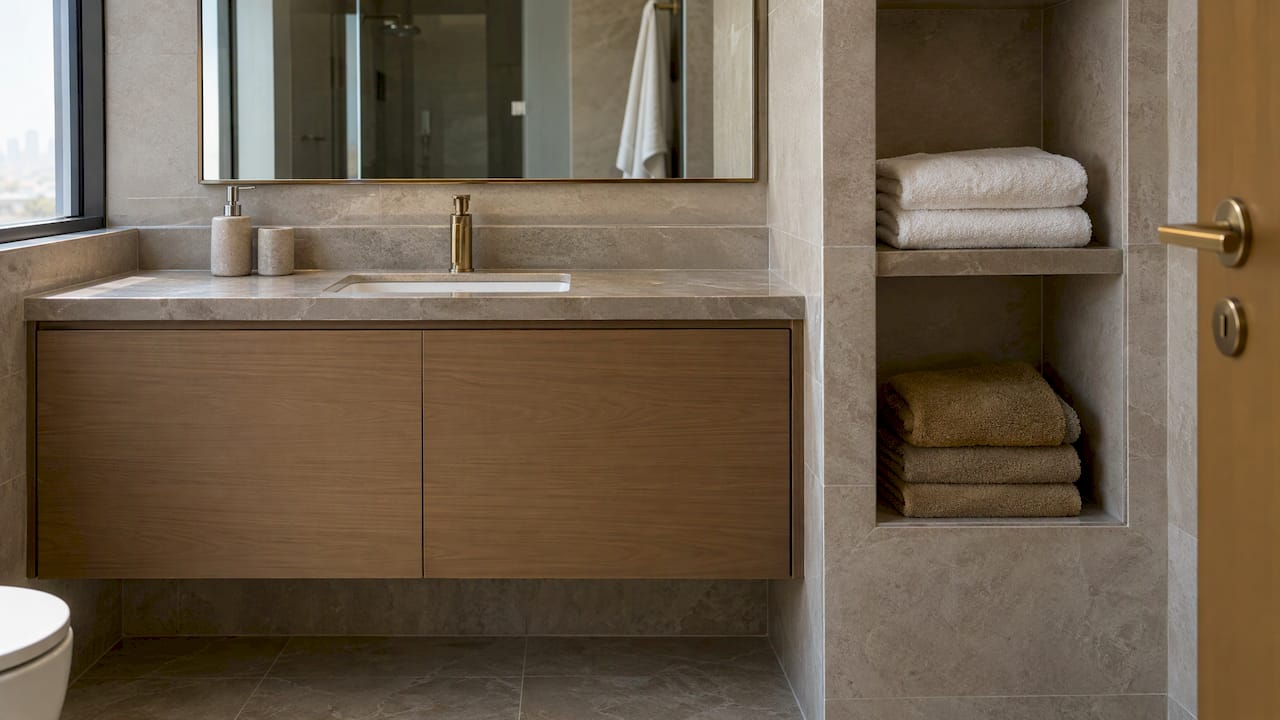
A spa bathroom needs plenty of storage, but none of it should be on show. One Dubai studio describes it as storage built into the vanity and recessed niches, with towels and robes given their own place and toiletries behind closed doors. The result is a quiet room where nothing distracts the eye.
The wider UAE direction is the same. Design Middle East notes a trend toward open-plan bathrooms that blend into master suites, with clean lines, rinse-free ceramics and minimalist forms. If your bathroom opens onto a bedroom, keep the materials continuous and the fittings simple.
Waterproofing and ventilation: the unseen spa features
This is the part that decides whether the bathroom still looks good in five years.
- Tanking. One Dubai renovation firm says proper tanking of wet zones is expected, with the membrane bonded to sound screed, turned up the shower walls at least 150 to 300 mm, dressed into the drain and water-tested for 24 hours before tiling. A steam enclosure also needs a tanked membrane behind the tile and a low-profile drain.
- Approvals. If you own a property and plan plumbing or drainage changes, a Dubai installer guide says Dubai Municipality approval applies and electrical work for electric shower units must be done by a DEWA-approved electrician. In an apartment, speak to your building management before work starts, and ask your installer for a waterproofing certificate.
- Ventilation. Good extraction reduces humidity and mould risk, a point the wet room guide stresses alongside waterproofing and accurate measurement.
- Details at the edges. Transitions between wet and dry floors need finishing properly. The role of trims in waterproofing is a good primer on why edges matter.
For family homes, anti-slip flooring and good lighting are part of a safe renovation, not extras.
Budgeting? A guide to planning a bathroom remodel budget helps you decide where to spend and where to keep it simple.
Water and energy efficiency
Spa comfort and efficiency are compatible. Design Middle East reports that Dubai’s 2025 Green Building Regulations require water-efficient fittings in new residential and hospitality projects, and that touchless taps, low-flow mixers and aerated shower systems are being built into modern interiors. Aeration keeps a rain head feeling full while using less water.
If efficiency matters to you, read our guides to energy-efficient apartments in Dubai and sustainable apartment design in the UAE.
Our perspective
Buyers often ask us which bathroom features are worth paying for. Our answer is to look at the whole home, not only the bathroom. A spa feature only works when the layout, ceiling height, ventilation and finishes around it are right.
That is how we approach our boutique residential developments: premium finishes, smart-home integration, wellness and fitness amenities and sustainable design, planned together from the start. We design for residents who want calm, quality and lasting value, rather than a long list of gadgets.
If you are choosing a new home, ask what the bathroom gives you on day one: space to move, good light, and a finish you will still enjoy years from now. Then add the personal touches that make it yours.
Mark
Find a home designed for wellness
If you want a home where wellness is part of the design from day one, explore our current developments. Lazord by Lapis and Azure by Lapis are boutique residential projects built around premium finishes, smart-home integration and wellness amenities.

You can see everything in one place on our off-plan projects page, or learn more about Lazord by Lapis in Majan. Speak to our team to arrange a call and discuss which home suits you.
FAQ
Is a steam shower or a sauna better for a UAE apartment?
For most apartments a steam shower is the better fit, because it can replace an existing shower and needs a smaller footprint. A sauna needs a separate room of at least 4 x 4 ft. Either way, plan for ventilation, a dedicated electrical supply and, for steam, careful waterproofing.
Do I need a freestanding bath for a spa bathroom?
No. A frameless walk-in shower with a rain head delivers the spa feel in a standard bathroom. A freestanding bath suits larger rooms, with a sensible minimum of about 7 sqm and clear floor around it. In smaller rooms, a built-in bath or a bigger shower is the better choice.
Which materials suit a humid bathroom?
Porcelain tiles with water absorption below 0.5% are recommended for wet zones. Natural stone such as travertine needs filling, sealing and annual resealing. Brass and stainless steel fittings resist corrosion in humid or coastal conditions.
What lighting creates a spa mood?
Use three layers: task light at the mirror, ambient light such as concealed strips or niche lighting, and one decorative fitting. Put them on dimmers so you can move from bright morning light to a soft evening glow.
Sources
- Bathroom Interior Design Dubai 2026: Spa Trends and Costs
- Luxury Master Bathroom Ideas in Dubai: 2026 Design Guide
- Bathroom Renovation in Dubai: A Practical Guide
- Wet Room Ideas
- Shower Head Height Guide
- Steam Shower, Sauna and Commercial Steam Room Buyers Guide
- Sauna vs Steam Room
- Sauna and Hamam Design in Dubai
- Freestanding vs Built-In Bath
- Freestanding vs. built-in bath tubs
- Freestanding vs. Built-In Bathtub
- The Spa at Home: How to Design a Luxury Wellness Bathroom
- How To Design A Spa-Inspired Bathroom At Home
- Interior Design and Renovation Trends for Dubai Homes
- Design Meets Wellness: The Modern UAE Bathroom Evolution
- Bathroom Design Dubai: Styles, Layouts and Materials
- Shower Installation in Dubai: Complete Guide for Homeowners
- The role of trims in waterproofing
- Affordable Bathroom Remodel