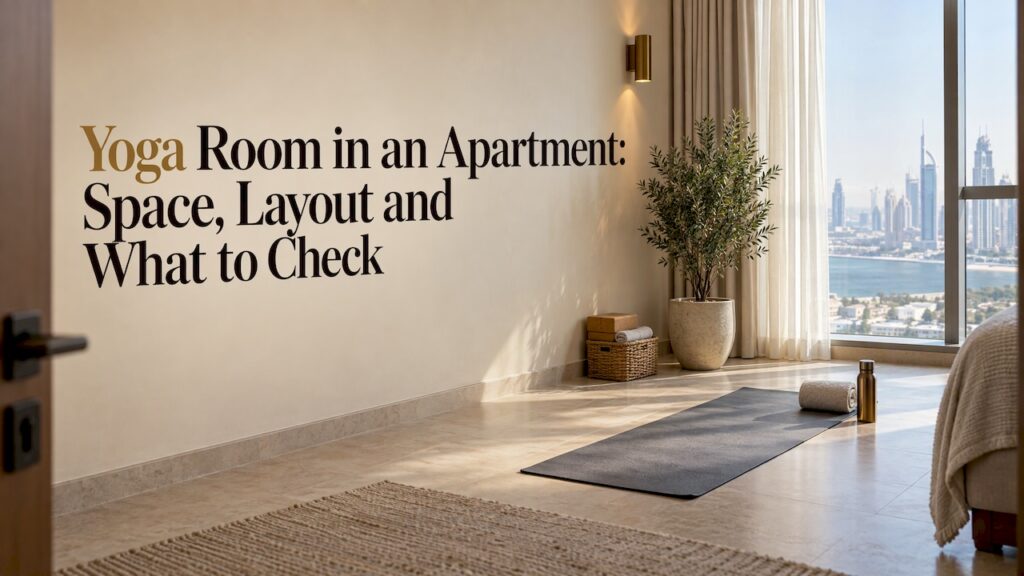
A yoga room in an apartment can be a dedicated room of about 10 by 10 feet, a clear 6 by 8 foot corner of your living space, or a shared studio in the building. Which one suits you depends on how often you practise, how much floor you can spare and what your building actually provides. This guide covers all three, with the measurements, floor, light and air-conditioning choices that make the space work in a UAE home, and the questions to ask before you buy or sign for a flat because of its yoga studio.
TL;DR
- A private yoga room is your own space in the home. An apartment yoga studio is a shared amenity in the building, usually alongside a gym.
- For most mat-based practice, plan a clear rectangle of about 6 x 8 feet. A dedicated room works best from 10 x 10 feet.
- Hard tile and air-conditioning vents are the usual problems in Dubai apartments. A thicker mat and a better mat position solve most of them without renovation.
- When a building advertises a studio, check access, fees, opening hours and guest rules, and get the answers in writing.
- Ceiling height, sound insulation and a calm layout matter as much as floor area when you choose a new home with practice in mind.
Table of Contents
- A private yoga room and a shared apartment studio
- How much space a yoga room needs
- Flooring: the real obstacle in many flats
- Light, air and temperature
- Making the space calm without renovating
- What to check when a building advertises a yoga studio
- Choosing a home that supports a daily practice
- Explore a Lapis home with wellness in mind
- Our perspective
- FAQ
- Sources
A private yoga room and a shared apartment studio
The two are often confused in listings, and they serve different habits.
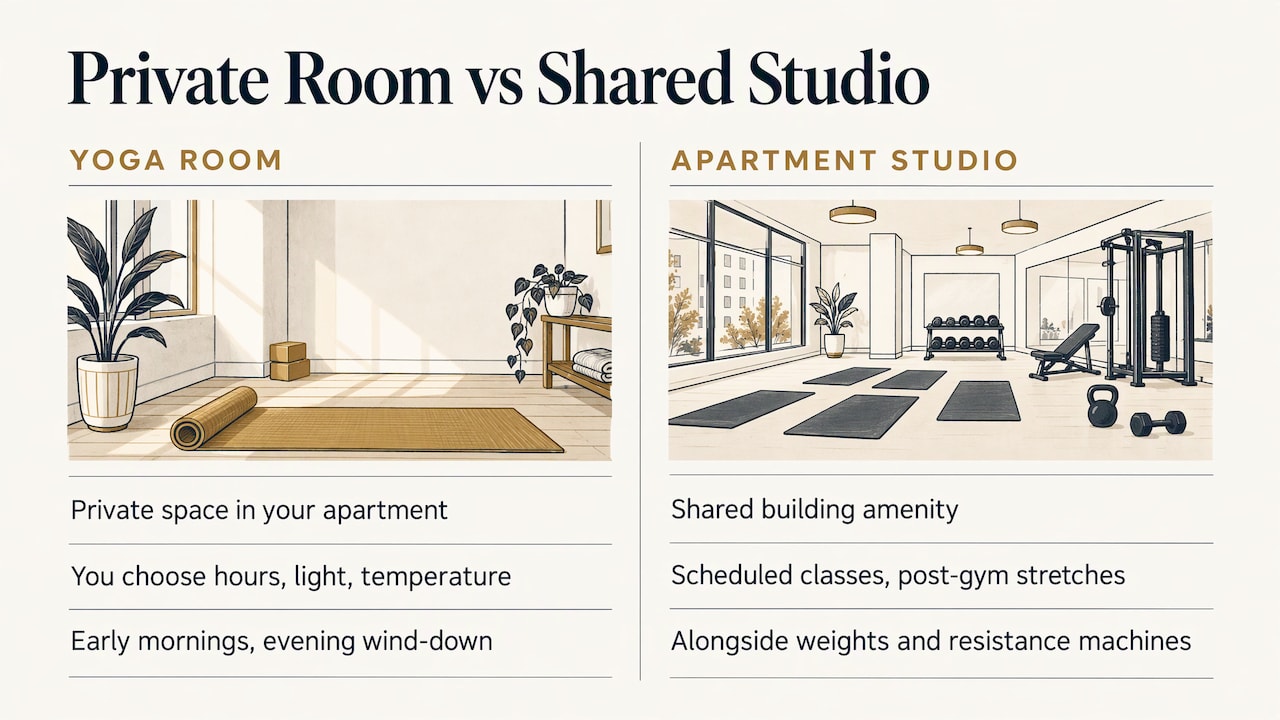
A yoga room is part of your own apartment. It may be a spare bedroom, a study you have cleared, or a corner of the living area with a mat and a little clearance. You decide the hours, the lighting and the temperature. Nobody else is in it.
An apartment yoga studio is a shared amenity. Buildings completed in the last three to four years typically include a dedicated yoga or stretching studio alongside free weights and resistance machines, according to one Dubai apartment guide. The same guide estimates that skipping a separate gym membership can save AED 3,000 to 6,000 a year, depending on the chain.
In practice, many residents use both. The building studio suits scheduled classes or a quick stretch after the gym. The room at home suits early mornings, evening wind-down and any session you would rather not share. When you search for a home, it helps to decide which of the two you really need, because a flat with a large shared studio and a small, awkward living room can serve you worse than the reverse.
How much space a yoga room needs
A standard yoga mat is about 24 x 68 inches, roughly 11.3 square feet, but you need room to move around it. For most mat-based yoga, a clear 6 x 8 foot rectangle is recommended, which is 48 square feet, with at least 7 feet of ceiling height for someone of average height reaching overhead. The same source notes that a 6 x 6 foot area can work for more static poses, or with the mat turned diagonally, and that below that size restorative yoga and seated stretching are realistic options.
If you want a room that is only for practice, the guidance is larger. Certified interior designer Jennifer Ho recommends a minimum of 10 by 10 feet, which leaves space for two people plus storage along one wall.
Two Dubai-based sources take a more relaxed view of small flats. One Dubai yoga centre says a six-by-six-foot patch of floor, cleared of furniture and sliding rugs, is enough for almost any sequence a private session might include. Another suggests that a 2 x 2 metre zone is enough for a full Hatha or restorative session, and offers a simple wingspan test: stand in the space, open your arms and turn a full circle. If you touch nothing, the space works.
| Space available | What it supports | Layout tip |
|---|---|---|
| Under 6 x 6 ft (about 1.8 x 1.8 m) | Restorative yoga, seated stretching | Keep the mat rolled in a cupboard and unroll it where you practise |
| 6 x 6 ft | Static poses, a diagonal mat | Turn the mat diagonally and clear the nearest furniture |
| 6 x 8 ft (about 1.8 x 2.4 m) | Most mat-based flows | Keep one long side free of furniture |
| 10 x 10 ft (about 3 x 3 m) | A dedicated room, two people, storage | Put storage along one wall and leave the centre open |
A quick way to test your own flat
Before you commit to a layout, do three simple checks.
- Lay the mat where you plan to practise and stand at each end with your arms overhead. Nothing should touch a wall, a lamp or a ceiling fitting.
- Do the wingspan turn described above.
- Look up. Low beams, hanging lights and bulkheads are easy to miss, and they matter in standing poses.
Ceiling height is a point buyers often overlook. If you are weighing flats with practice in mind, our guide to high ceilings in UAE apartments explains what to look for.
Flooring: the real obstacle in many flats
Space is rarely the main problem. Lalitha Viswanath of Pratimoksha Yoga Center in Oud Metha, Dubai, says flooring is the more common obstacle, and that neither issue requires renovation: the session layout can be adjusted instead.
Hard tile, common in many Dubai apartments, can be uncomfortable without a proper mat, and a thick rug under the mat makes balance poses unstable. The practical choices are:
- Cold ceramic tile: use a mat at least 5 mm or 6 mm thick, as Yogaathome advises.
- Slippery laminate: the same source recommends a high-grip polyurethane mat.
- Rugs: remove them from the practice area, or choose a flat-weave that does not slide or bunch.
If you are building or fitting out a room from scratch, GADI Construction suggests resilient flooring such as engineered cork or bamboo over a high-density cork underlayment. That is a bigger project than most apartment owners need, and a good mat on a clean, level floor is enough for most people.
Light, air and temperature
Lighting
Harsh overhead light is tiring in reclined and restorative poses. GADI Construction specifies layered, dimmable indirect lighting between 2700K and 3000K rather than direct downlights. Jennifer Ho makes a similar point: she recommends soft wall sconces that direct light upwards, fitted with a dimmer, and advises avoiding recessed, downward-directed lights that can disturb the eye when you are lying down.
In a flat where you cannot change fixtures, a warm-bulb floor lamp pointing at a wall and a dimmable lamp on a side table achieve much of the same effect.
Air-conditioning and ventilation
In the UAE, air-conditioning decides whether a room is usable at 6am or 6pm. Vents pointed straight at the practice area are a frequent issue. Move the mat out of the direct airflow, or angle the louvres upward, before you consider anything else. Yogaathome suggests a temperature zone of roughly 23 to 24 degrees Celsius for practice.
For a purpose-built room, GADI Construction recommends continuous mechanical air turnover, humidity between 30 and 50 per cent and at least 15 CFM of fresh air per occupant. If you want to understand how cooling systems balance efficiency and comfort, this overview of home air conditioning options is a useful starting point. For the building side, our guide to energy efficient apartments in Dubai covers what keeps a home comfortable without overworking the cooling.
Making the space calm without renovating
Most people do not have a standalone yoga room. Jennifer Ho observes that sanctuary spaces at home are often multi-functional, shared with a meditation room, a bedroom or an exercise room. Kelly Clifton Turner of YogaSix goes further, saying a home practice needs little beyond a space about the size of a mat.
A few changes make a shared space feel like a practice room:
- Clear a fixed spot. The easier it is to unroll the mat, the more often you will.
- Store the kit in one place. A basket, a shelf or a slim cabinet holds the mat, blocks, strap and bolster. A tidy system helps, and these small-space organisation ideas show how to stop clutter returning.
- Soften the walls. Neutral colours, a single plant and a closed door signal that this is a quiet zone.
- Mind the noise. Sound carries between apartments and between rooms. A rug on the walls’ side, a closed door and a quiet corner away from the lift or the kitchen help. If noise is a concern when buying, see our guide to soundproofing in apartments.
- Use the balcony wisely. Early morning or evening, a shaded balcony with a sea or skyline view can be the best room in the flat.
What to check when a building advertises a yoga studio
A studio in the brochure is only useful if you can use it. Whether you rent or buy, the questions are the same, and the answers should be in writing.
Villavow advises asking building management, not the landlord, what your specific unit type is entitled to use, what registration access requires, whether any facility carries a separate fee, and what the guest policy is. It recommends getting those answers by email before paying a deposit. TryBeforeDubai adds that you should see the gym, pool and other facilities during the viewing and ask residents how often they are open and usable.
A short checklist for your viewing:
- Walk to the studio itself. Check its size, floor, mirrors and ventilation.
- Look at the access gates and card readers.
- Read the opening-hours notice.
- Ask whether the studio can be booked, and whether classes are run by the building or by outside teachers.
- Ask what is included in the service charge and what costs extra.
- Ask what the rules are for guests and for children.
For buyers, the same discipline applies to off-plan purchases: ask which amenities are part of the approved plans and what the community will look like when the building is complete. Our piece on community living in Dubai helps you judge a neighbourhood as well as a building.
Choosing a home that supports a daily practice
If you are buying, a short list of features decides how well a flat serves a yoga routine:
- A room or corner of at least 6 x 8 feet that is not the main walkway.
- Ceiling height that lets you reach overhead without hesitation.
- Good natural light and a view, which make morning practice easier to keep up.
- Quiet, from both neighbours and building services.
- Controllable cooling, so you can set a comfortable temperature in the practice area.
- Wellness and fitness amenities in the building for the days when you want a class or a longer stretch.
- A sustainable build, because comfort and running costs are linked. Our guide to sustainable apartment design in the UAE explains what this means in practice.
Explore a Lapis home with wellness in mind
Lapis Properties develops luxury residential properties in Dubai and Ras Al Khaimah, including seafront and waterfront apartments and boutique residential towers. Our developments are designed around features such as private plunge pools, smart-home integration, premium finishes, wellness and fitness amenities and community spaces.

If you want a home where a calm daily routine fits naturally, look at Azure by Lapis and Lazord by Lapis, where starting prices are published on each project page. You can also browse all off-plan projects and enquire about the layout that suits you.
Our perspective
A good yoga room is rarely about square metres alone. It is about the feeling of stepping into a space that is quiet, well lit and comfortable the moment you open the door.
That is how we think about design at Lapis. We build boutique-scale residences, so each home can be planned with care for light, finishes, sound and flow. We combine this with wellness and fitness amenities and community spaces, so residents can choose between a private practice at home and shared facilities close by.
Sustainable design supports the same goal. A home that is thoughtfully built is easier to keep comfortable, and that comfort is what turns a good intention into a daily habit.
When you view a home with us, we encourage you to bring your own checklist: where would the mat go, where does the light fall, and how does the space feel in the morning? Our team is glad to talk you through the options.
Mark
FAQ
What is a yoga room called?
A room for yoga is usually called a yoga room or yoga studio. In a building, the shared version is described as a yoga studio or wellness studio, often next to the gym. At home, it may simply be a practice corner or a multi-purpose room used for yoga and meditation.
How big should a yoga room in an apartment be?
For most mat-based practice, a clear rectangle of about 6 x 8 feet works well, with at least 7 feet of ceiling height. For a dedicated room that can hold two people and storage, the guidance is 10 by 10 feet or more. Smaller spaces still suit restorative and seated work.
Can I practise yoga on tile or laminate floors?
Yes, with the right mat. On cold ceramic tile, a mat of 5 mm or 6 mm or thicker is more comfortable, and on slippery laminate a high-grip polyurethane mat helps. Avoid placing a thick rug under the mat, as it makes balance poses less stable.
What should I ask if my building has a yoga studio?
Ask building management what your unit type can use, what registration is required, whether there is an extra fee and what the guest policy is. Villavow recommends getting the answers in writing by email. Also visit the studio during your viewing and check the opening hours.
Sources
- 12 Everyday Comforts That Make Luxury Apartments Worth the Investment
- How Much Space Do You Need for Yoga or Pilates at Home?
- Making Space For Yoga At Home, Forbes
- The Space and Equipment a Home Yoga Session Actually Needs
- Creating a Yoga Space in a Small Apartment
- Creating A Yoga Studio Within Your Existing Floorplan
- Pool, Gym and Amenity Access Mistakes That Cost UAE Renters
- How to vet a Dubai building before you sign
- Home air conditioning: efficiency, comfort and real options
- Small Space Organization: 10 Moves to Keep Clutter From Returning