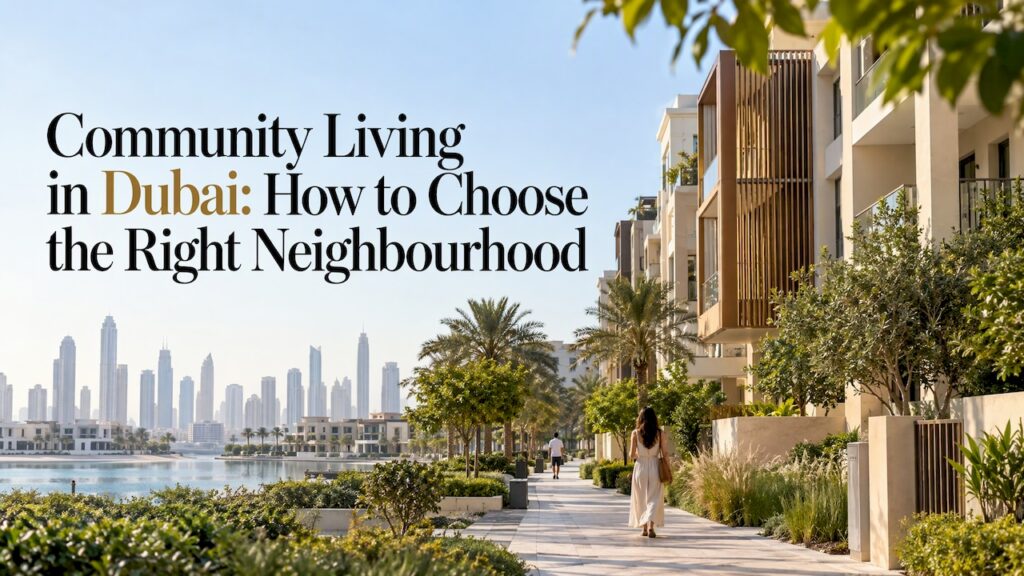
Community living in Dubai comes in two broad forms: high-rise, mixed-use districts where cafes, transport and services sit on your doorstep, and quieter gated suburbs built around villas, parks and schools. The right choice depends on how your household moves through a normal week. Judge a community by the daily routes, shared facilities and running costs it offers, not by the brochure.
This guide explains how Dubai’s communities differ, what makes one family-friendly or walkable, which amenities matter, and the practical checks to make before you sign.
TL;DR
- Dubai communities fall into vertical, mixed-use districts and gated suburban neighbourhoods. The main difference is how easily you reach amenities without a car.
- Walkability depends on shade, safe crossings and daily services close together, not on a long amenity list.
- Test every amenity against your own routine: the route, opening hours, capacity and upkeep decide its value.
- Compare total cost of living, including service charges and commute, not just the purchase price.
- Visit at rush hour and in the evening, and confirm that any amenity marked “planned” is built and working.
Table of Contents
- What community living in Dubai actually involves
- Family-friendly communities: what to look for
- Walkable communities: what the term should mean
- Which community amenities matter most
- The trade-offs: space, privacy, travel time and cost
- Our perspective on community living
- Where Lapis Properties fits
- How to shortlist a community: a step-by-step method
- FAQ
- Sources
What community living in Dubai actually involves
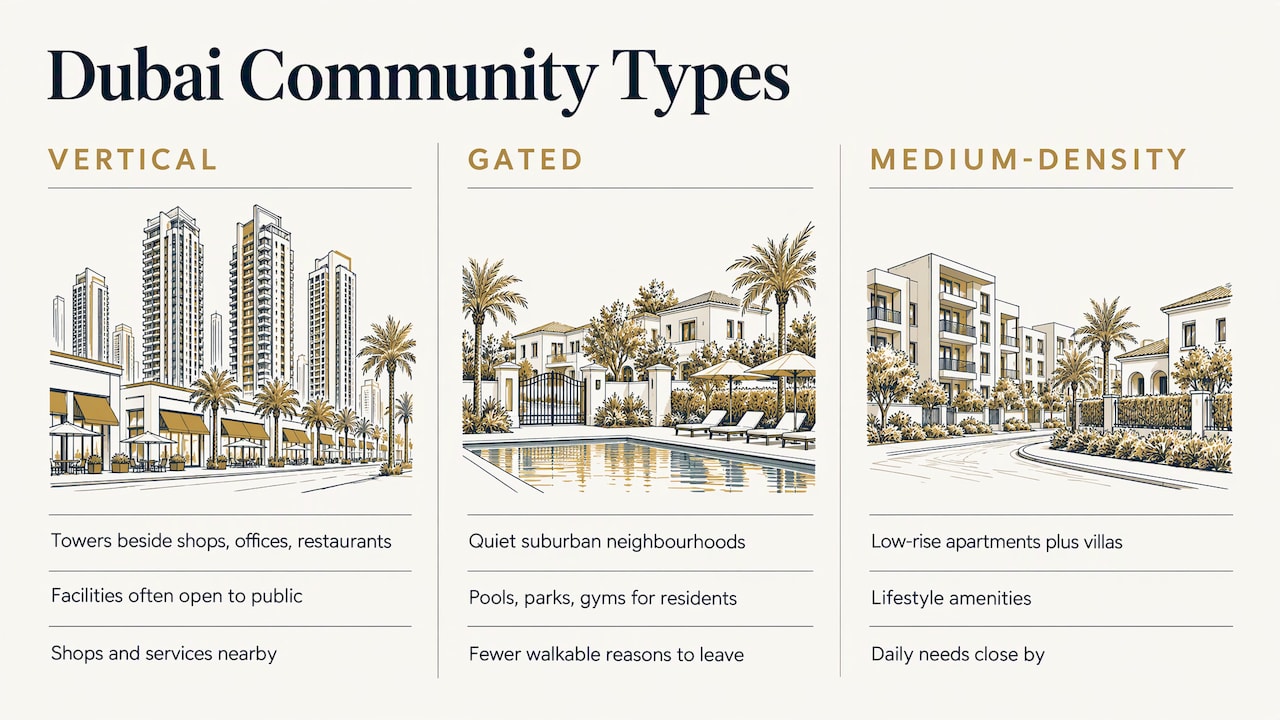
Most buyers choose between high-rise vertical communities in urban centres and quiet gated suburban neighbourhoods. The two feel very different day to day.
In a vertical, mixed-use district, residential towers sit alongside shops, restaurants and offices. Facilities are often open to the wider public. In a gated community, pools, parks and gyms are typically restricted to residents and their guests, which gives more privacy and a quieter street, but fewer spontaneous reasons to leave your front door on foot.
A third model is growing. Medium-density developments combine low-rise apartments with villas and lifestyle amenities, aiming for a live-work-play pattern in which daily needs are close by.
The city itself is steering in this direction. The Dubai Quality of Life Strategy 2033 includes more than 200 projects, initiatives and plans across ten pillars, and it aligns with the Dubai 2040 Urban Master Plan, including 20-minute city and soft-mobility initiatives. For a buyer, that means the neighbourhood around your home is likely to keep improving for pedestrians, cyclists and families.
What makes a community feel like one
A brochure can list a hundred amenities and still describe a place where neighbours never meet. A community feels real when it has three things:
- Design that puts people before cars. Wide roads and high-walled private plots discourage chance encounters. Shaded paths and narrower streets invite them.
- Shared “third spaces”. These are places that are neither home nor work: a lakeside promenade, a local cafe, a community centre, a pocket park.
- Active resident culture. Clubs, markets, school-run friendships and resident committees turn a collection of homes into a neighbourhood.
When you tour a development, look for these before you look at the gym.
Family-friendly communities: what to look for
Families tend to start with the same shortlist: schools, healthcare, green space and safe outdoor areas. A sensible framework weighs KHDA school ratings, access to green space, proximity to healthcare and walkability together rather than any single factor.
Schools and the daily run
A school’s rating matters, but so does the journey. Check the actual route at drop-off time. A school ten minutes away on a map can become thirty minutes in morning traffic. If two parents work in different parts of the city, map both commutes before you fall in love with a home.
Parks, pools and play areas
Standard community amenities include swimming pools, fitness centres, children’s play areas, parks, retail centres, clinics and eco-friendly outdoor areas, as listed in a guide to UAE community living. The detail that decides everyday value is where they sit relative to your unit.
One practical tip from a buyers’ guide for family-oriented communities: inspect the closest pool and park from the unit itself. An amenity advertised as “near” can bring extra noise, or can require children to cross internal roads. The same guide suggests asking about community rules, pool access, landscaping responsibilities, and any restrictions on pets or on changes to exterior and garden areas.
A quick family checklist
- Is there a safe, shaded route to the park or play area that a child can use with an adult?
- Can you reach a clinic or pharmacy without driving?
- Are pool hours and capacity realistic for the number of households?
- Are pet and garden rules compatible with how you live?
- Do the nearest schools have places, and what is the realistic journey at 7:30 am?
Walkable communities: what the term should mean
“Walkable” is one of the most overused words in Dubai property marketing. In practice, a walkable community has shaded pedestrian paths, sensible street crossings, and daily amenities clustered within a reasonable radius.
The city’s planners are formalising the idea. A new urban planning model approved by His Highness Sheikh Hamdan bin Mohammed prioritises active mobility through shaded walkways that connect service centres to homes, with plans to add 152 parks in specific districts. That is the direction of travel, but it applies district by district, so check what is built in the area you are considering rather than what is planned.
Dense waterfront versus spacious suburb
Waterfront high-rise districts such as Dubai Marina offer density and easy walks to cafes and transport. The trade-off is that a private garden is out of the question. Gated suburban communities offer more villa space and a quieter feel, but daily errands usually involve a car. Neither is better in the abstract. It is a question of which trade-off you would rather live with.
Test the routes yourself
Some of the most useful advice for buyers is to look past the amenity checklist. Neighbourhoods that let residents run regular errands without driving matter more than a long list of facilities. Walk or drive these four journeys:
- The grocery run, from your door to the nearest supermarket and back with bags.
- The school route, at the time you would actually travel.
- Delivery access: where do couriers and ride-hailing cars stop?
- The evening return, when traffic and parking are at their worst.
Also look at the surface of the route: pavements, crossings, shade, and the gates or entrances you must pass through. A park 300 metres away in a straight line is of little use if the only access is a 1.2 km loop around a perimeter wall.
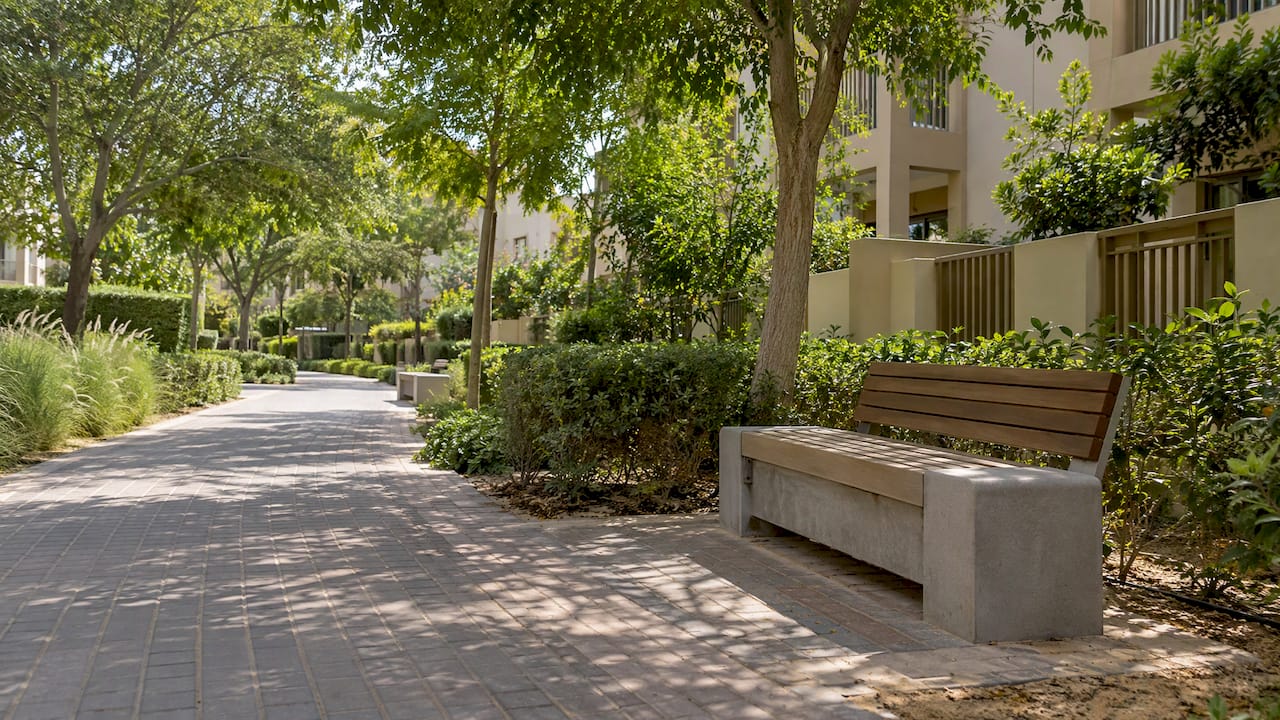
Shade and planting do real work here. Thoughtfully landscaped outdoor spaces with seating, paths and greenery are what turn a walkable layout on paper into somewhere people actually linger and talk to each other.
Which community amenities matter most
The amenities that matter most are the ones that fit your household’s regular routine: daily services, family needs and lifestyle facilities you will use weekly rather than once. A rooftop lounge you visit twice a year counts for less than a pharmacy you use every fortnight.
Separate what is inside from what needs travel
Before you buy, divide the amenities into two lists. The first covers what is inside the development, such as a pool, gym or play area. The second covers services that need a journey, such as a supermarket, clinic or school. Then check each against your schedule. Do not assume something is convenient just because it appears in a brochure or area guide.
How to judge quality and upkeep
A facility is only as good as its management. Test the basics yourself:
- Building systems. Check air conditioning, plumbing, appliances and common areas. Apartment buyers should test building systems and shared areas, while townhouse buyers should add deeper checks such as roofing and waterproofing.
- Service charges. Ask for the service-charge statement and maintenance records, and confirm whether the property transfers with any outstanding community dues.
- Responsiveness. Ask how defects are reported and resolved after handover, and how consistently common areas are kept up.
- Capacity and hours. Find out when the pool, gym and courts are open and how crowded they get at peak times.
Off-plan buyers: confirm what is actually built
If an amenity is shown as planned or under development, ask the responsible provider or an official source to confirm its status and timeline before it influences your decision. Where possible, visit the site and test the journey yourself. For off-plan purchases, make sure the shared facilities you are paying for are part of the delivered phase, not a later one.
The trade-offs: space, privacy, travel time and cost
Every community asks you to give something up. A villa suburb gives you space and privacy and takes away walkability. A marina tower gives you cafes and transport and takes away the garden. A medium-density development tries to split the difference.
Compare the total cost of living
Do not compare only the purchase price or the annual rent. Compare the total cost of living in each community: service charges, parking, school fees, cooling costs and the time and fuel your commute takes. A cheaper home far from work or school can cost more across a year.
Visit when the area is busiest
Viewing a property at midday can mislead you, because the neighbourhood is at its quietest. A better test is to visit on a weekday between 7:30 and 9:00 am to see traffic and again in the evening to judge noise and parking, as one neighbourhood assessment guide recommends. Do it twice if you can: once on a weekday, once at the weekend.
A simple comparison
| Factor | High-rise mixed-use district | Gated suburban community | Medium-density development |
|---|---|---|---|
| Walking to cafes and transport | Usually easy | Often needs a car | Designed to be close by |
| Private outdoor space | Balcony or terrace | Garden or private plot | Mix of terraces and gardens |
| Facilities | Often shared with the public | Residents and guests only | Residents, with some shared public areas |
| Feel | Urban, busy | Quiet, private | Neighbourly, lower rise |
| Main thing to check | Noise and parking | Commute and school runs | What is built versus planned |
Our perspective on community living
We build boutique residential developments, and we believe scale matters. A smaller building means fewer households sharing the lift, the pool and the lobby, so facilities stay usable and neighbours actually recognise each other.
We design with daily life in mind: wellness and fitness amenities, community spaces, smart-home integration, premium finishes and, in some of our towers, private plunge pools. The idea is that the things you use every week sit within the building itself, without a journey.
Sustainability is part of how we think about community too. Good insulation, efficient systems and thoughtful materials make a home more comfortable and can help keep running costs in check. If you would like to see how we approach this, read our guides on sustainable apartment design in the UAE and energy-efficient apartments in Dubai.
Our advice to every buyer is the same: ask where you will spend your mornings, your evenings and your weekends, then choose the place that makes those hours easier.
Mark
Where Lapis Properties fits
If you are drawn to boutique, design-led living on the waterfront, our developments are built around that idea. Lazord by Lapis is a boutique residential project in Majan, with the thinking behind it set out in our guide to luxury living in Majan. Azure by Lapis is another of our projects. Both are listed with a starting price on their pages: you can see the current details for Azure by Lapis and Lazord by Lapis.

We work with first-time buyers, families and investors, and we offer a personalised experience from first enquiry onwards. To compare our current developments side by side, browse our off-plan projects, or get in touch via the Lapis Properties website to arrange a call.
How to shortlist a community: a step-by-step method
Pulling the points above into a process makes the decision easier.
- Write down your week. List the places your household goes: work, school, gym, supermarket, family, worship, leisure. Rank them by frequency.
- Choose the model. Decide whether you lean towards vertical convenience, suburban space or something in between.
- Shortlist two or three communities. Use official planning information to see what is built and what is planned.
- Run the four journeys. Grocery, school, delivery and evening return, at the real times.
- Inspect the amenities from the unit. Walk from the front door to the pool, the park and the gym. Note noise, crossings and entry points.
- Ask for the paperwork. Service-charge statement, maintenance records, community rules and confirmation of any outstanding dues.
- Compare total cost. Add service charges, commute and household running costs to the price.
- Return at a different time. A second visit in the evening or at the weekend often changes the picture.
FAQ
Which type of Dubai community suits families best?
There is no single answer, but families usually value schools, green space, healthcare and safe walking routes together. Gated suburban communities and medium-density developments tend to offer more outdoor space and quieter streets. Check the school route at peak time and the walk to the nearest park before you decide.
What makes a community in Dubai walkable?
Shaded pedestrian paths, sensible street crossings and daily amenities clustered within a short radius are the essentials. Dubai’s planning direction supports this through its 20-minute city and soft-mobility initiatives. Test the routes you would actually use, including the grocery run and the evening return, rather than relying on distance on a map.
Which amenities matter most when buying?
The ones that match your weekly routine: daily services, family facilities and a pool or gym you will really use. Ask about opening hours, capacity and maintenance, and request the service-charge statement. Confirm that anything shown as planned has been completed and is operating.
Is a gated community always better?
Not necessarily. Gated communities give privacy and restricted facilities, which many families like. They can also mean more driving for daily errands. Weigh that against the convenience of a mixed-use district and ask about community rules on pets, gardens and pool access.
Sources
- What to Expect from Community Living in the UAE
- Dubai Quality of Life Strategy 2033
- Dubai’s new-gen communities will thrive on live-work-play
- New urban planning model for residential areas in Dubai
- Mira Oasis 2: guide for buyers and families
- Springs 9 Dubai: guide for buyers and investors
- MAG City: guide for Dubai buyers and investors
- Landscaping and hardscaping projects