The most effective way to soundproof an apartment is to work in order: find the path the noise takes, seal the gaps, add mass to the surface that carries the sound, and only then soften the room itself. Most complaints in UAE apartments come from three things: gaps around doors, impact noise through floors and echo in rooms full of hard finishes, according to a Dubai soundproofing guide from 2026. Each has a different fix, and the wrong fix is the most common waste of money.
This guide covers what you can do as a tenant, what you can do as an owner, what it tends to cost, which permissions to ask for, and what to look for if you are buying and want a quieter home from the start.
TL;DR
- Soundproofing stops sound travelling between spaces. Acoustic panels only tame echo inside a room, so they will not stop a neighbour’s music.
- Start with cheap, reversible fixes: door seals, a drop-bottom sweep, underlay or rugs, and heavy curtains. Seal every air gap before adding anything else.
- Lasting results come from combining sealing, added mass and decoupling. A single “magic” material rarely delivers.
- Get written permission from building management or the developer before touching common walls, structure or the facade.
- If you are buying, ask about acoustic specifications before you sign, because it is far cheaper to have a quiet building than to retrofit one.
Table of Contents
- Soundproofing and acoustic treatment are not the same thing
- Find where the noise is coming in
- Quick wins that need no alterations
- Doors and windows
- Walls
- Floors and ceilings
- What soundproofing costs in the UAE
- Permissions and rules to check first
- Our perspective
- Choosing a quieter apartment from the start
- Looking for a quieter new home?
- FAQ
- Sources
Soundproofing and acoustic treatment are not the same thing
This is where most people go wrong. The two terms describe different jobs.
Sound insulation, or soundproofing, controls how sound passes between spaces. Dubai site-inspection guidance describes it as dealing with sound that enters from neighbouring rooms or corridors. Acoustic treatment controls how sound behaves inside one room: echo, build-up of noise and how clear speech is.
The practical consequence is simple. One UAE acoustics firm explains that panels which improve room acoustics do not automatically stop outside noise from entering. SoundGuys makes the same point: treatment reduces reverberation and improves listening, but it does not materially reduce sound passing into or out of the room.
So if your living room sounds like a stairwell, panels and rugs will help. If you can hear your neighbour’s television at 11 pm, they will not.
Find where the noise is coming in
Before you spend anything, spend an evening listening. A practical diagnostic sequence is to stand at the shared wall, floor, ceiling, door and window while the noise is happening. The loudest surface is a likely main path.
Then check the less obvious routes, which sound engineers call flanking paths. The same guide lists ducts, electrical boxes, skirting gaps and the junctions where floors or windows meet walls. Sound that cannot go through a wall will happily go around it.
A few questions help you narrow it down:
- Is it voices and television? That is airborne sound, usually through a party wall, a door or a vent.
- Is it footsteps or dragged furniture? That is impact noise travelling through the floor structure.
- Is it deep bass? Low frequencies travel through structure and are the hardest to stop.
- Is it traffic or construction? Look at windows, balcony doors and the gaps around them first.
- Is it your own echo? Hard tiles, glass and bare walls cause this, and treatment is the right answer.
Professional assessments take this further. One UAE consultancy checks walls, ceilings, windows and doors, looks at flanking paths through vents and structural joints, and uses frequency and decibel analysis to tell room-acoustics problems from sound-isolation problems. If the noise is severe or you plan to spend serious money, a survey before choosing materials is sensible. Another Dubai firm points out that a survey identifies the surfaces that really cause the problem, rather than assuming it is the most visible one.
Quick wins that need no alterations
If you rent, or simply want to start cheaply, begin here. Structural treatments are expensive and may need approval, so reversible changes come first. The renter-friendly options named in a Dubai guide are door seals and drop-bottom sweeps, acoustic carpet or floor underlay, and heavy acoustic curtains near windows.
Seal the gaps first
Air gaps are the cheapest weakness to fix and the most overlooked. A door with a gap underneath lets through almost everything a solid wall would block. Fit perimeter seals around the frame and a drop seal at the bottom. Check around electrical sockets on shared walls and at the skirting too.
Soften the room
Rugs, upholstered furniture, bookshelves and curtains absorb sound inside the room. They will make the space feel calmer and reduce echo. Treat them as a comfort measure, not a barrier against a loud neighbour.
Skip the egg cartons
They are a myth. A Dubai soundproofing guide from 2026 says plainly that egg cartons do not provide effective soundproofing. Put the money into door seals instead.
Doors and windows
For a flat in a tower, doors and windows are often the weak points, particularly on a busy road or near a corridor.
Doors. A hollow door is light and leaks sound. The same Dubai guide recommends solid-core doors fitted with perimeter and drop seals. If you cannot replace the door, seals on the existing one still make a clear difference.
Windows. Double glazing is the standard answer for road and outdoor noise. Acoustic glazing units are sold specifically for this, and the thickness of the glass and the air gap matter more than the label. The cost is significant, so see the figures below. For a cheaper step, heavy curtains help with echo and a little with noise, and sealing gaps around frames helps most.
If you own the apartment, balcony doors and sliding systems deserve attention. Sliders often leak sound at their tracks and meeting points.
Walls
This is the question most readers ask: how do I soundproof walls in an apartment?
Three principles apply, summarised in a Dubai guide: add mass (for example sound-rated drywall), decouple the structure (resilient channels are one method), and seal every air gap with acoustic sealant. For voices or television through a party wall, the same guide advises using mass plus separation and sealing flanking gaps.
Another practical guide notes that sound reduction is cumulative. Sealing, added mass and decoupling together work best, while isolated “magic” materials usually fail. That is why a single layer of foam on a wall disappoints.
A few practical points:
- Bookshelves filled with books on a shared wall add some mass and are completely reversible.
- An independent partition built just in front of the party wall gives the best separation, but it takes floor area and needs approval.
- Acoustic panels are the right tool for echo. Where the noise is coming through the wall, they are not.
Floors and ceilings
Impact noise, such as footsteps, is different from voices. It travels through the structure and needs a different approach.
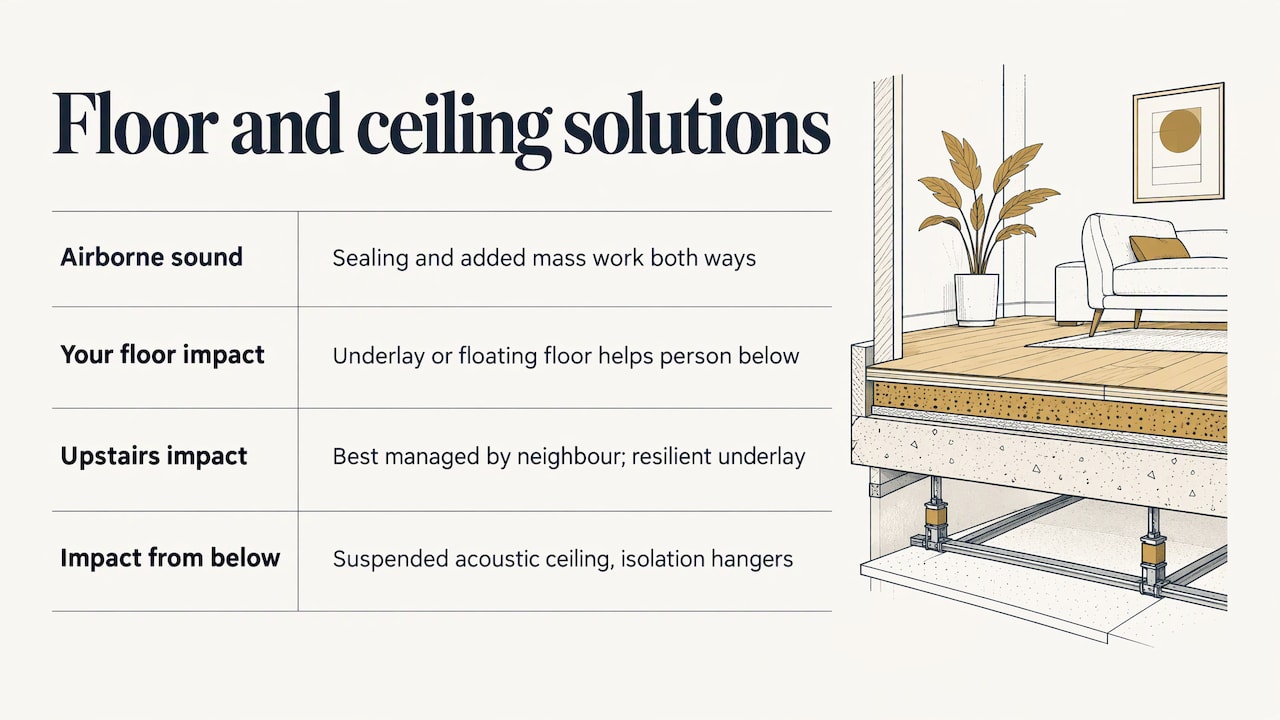
If you want to reduce noise you make on your own floor, acoustic underlay or a floating floor system can help. Note the direction, though: a floating floor helps the person below you, not you, if the noise comes from upstairs. The same guide says impact noise from an upstairs neighbour is best managed by the neighbour, for example with resilient underlay.
So, does soundproofing work both ways? Only partly. Sealing and added mass help in both directions, because they block airborne sound whichever side it starts from. Impact solutions are directional, and the work belongs on the side where the impact happens.
If the noise comes from above and you must deal with it from below, the guide recommends a suspended acoustic ceiling on isolation hangers. It costs ceiling height, which matters in a flat with a standard 2.6 m or so floor to ceiling. Our guide to high-ceiling apartments in the UAE explains why that height is worth looking at when you buy.
Deep bass is the hardest case. According to SoundGuys, structure-borne bass may require floating walls or floors, or shock-mounted ceilings. That is a job for a specialist, not a weekend.
What soundproofing costs in the UAE
Prices vary with access, floor level, service-lift charges and after-hours work. As a guide, one Dubai contractor’s 2026 breakdown puts the following ranges:
| Item | Indicative cost |
|---|---|
| Acoustic underlay | AED 40 to 79 per m² |
| Double-glazed acoustic units | AED 1,200 to 1,500 per m² |
| Structural package for one bedroom (walls, ceiling, doors) | AED 20,000 to 38,000 |
Treat these as a starting point and get at least two written quotes for your own apartment, since the same room can price very differently on the 5th floor and the 45th. Ask what each quote includes: materials, labour, lift booking, building fees and waste removal.
A useful rule: spend the first few hundred dirhams on seals and rugs, and see how far that gets you before you commit to a structural package.
Permissions and rules to check first
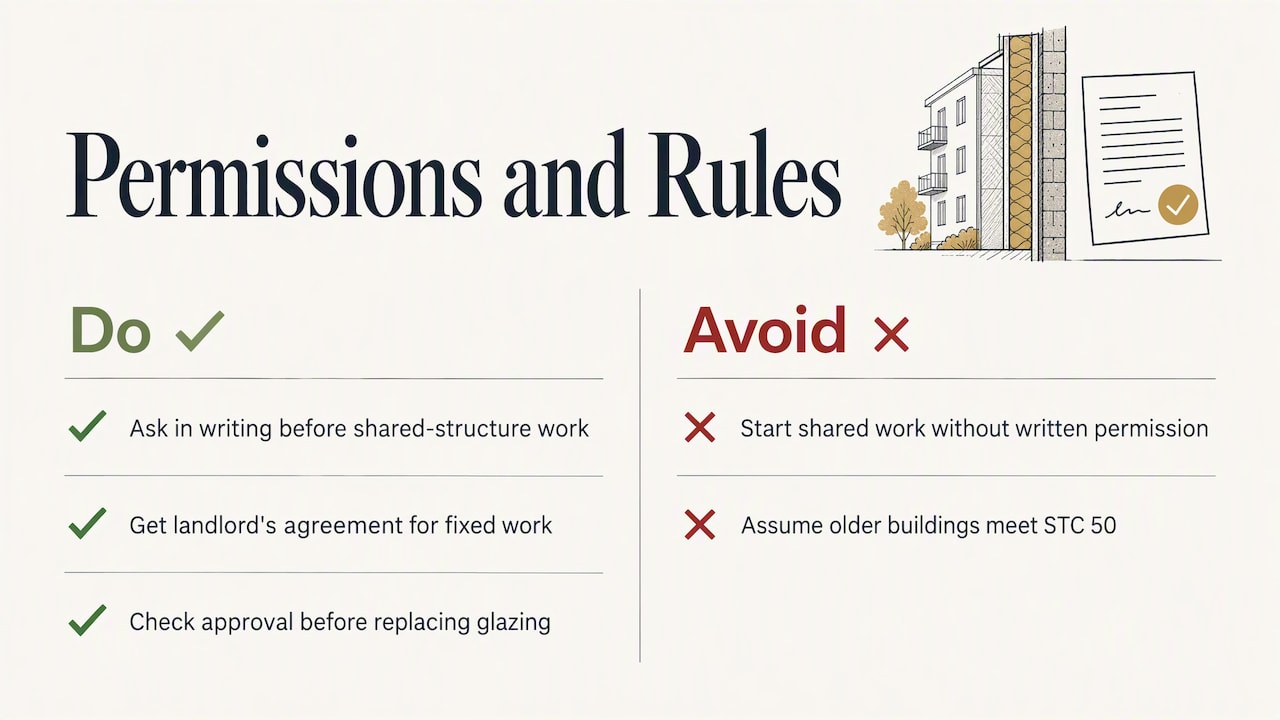
Before any work that touches shared structure, ask in writing. In Dubai, alterations affecting common walls, structures or facade uniformity generally need written permission from building management or the developer. An independent partition or changes to a common wall may also require approval. Replacing glazing can affect the facade, so ask about that before ordering.
If you rent, your landlord has to agree to anything fixed. Stick to reversible items unless you have it in writing.
For new buildings, there are performance expectations. An acoustic standards summary states that Dubai Al Sa’fat mandates acoustic performance criteria for new residential buildings, and that the Dubai Green Building Regulations require STC 50 or above between dwelling units. Older buildings may not meet that level, which is why some flats are noisier than others.
When the noise is a neighbour’s problem
Sometimes the right answer is a conversation, then a complaint. A 2026 guide to Dubai’s residential noise rules gives limits in quiet residential areas of 40 to 50 dBA by day (7 AM to 8 PM) and 30 to 40 dBA at night (8 PM to 7 AM). The same source says complaints can be filed through the Dubai Municipality app, by email to [email protected] or by calling 800900. Check the current rules on the official channel before you rely on any figure.
Our perspective
Most soundproofing advice treats quiet as something you add after the keys are handed over. We see it the other way round. The best acoustic result in an apartment comes from decisions made before construction: the scale of the building, how many homes share a wall or a floor, the quality of the finishes and how doors and glazing are fitted.
That is one reason we build at boutique scale. Fewer residences, premium finishes and thoughtful design give us more control over how each home feels, and our approach to sustainable design points the same way, because a well-sealed, well-built home is quieter and more efficient at once. Our guides on energy-efficient apartments and sustainable apartment design cover the overlap.
Our advice to any buyer is to ask the developer direct questions about acoustics, in writing, and to visit the home at different times of day. A good developer will welcome it.
Mark
Choosing a quieter apartment from the start
Retrofitting is possible, but buying well is cheaper. When you view a new development or a resale unit, check these:
- Position. Which rooms share a wall with a neighbour, a lift shaft, a plant room or a corridor? Bedrooms away from those are quieter.
- Glazing. Ask for the glazing specification and whether it is designed to reduce noise, not just heat.
- Doors. Solid doors with proper seals, including the entrance door.
- Floor build-up. Ask what lies under the finish, since underlay and floor construction decide impact noise.
- Building services. Lifts, pumps and ventilation can be heard through walls. A private lift apartment changes who shares what, so read what to check before you buy.
- What the contract promises. Ask which acoustic performance criteria the building was designed to, and get the answer in writing.
- Visit at different times. Go on a weekday evening and a weekend morning.
Looking for a quieter new home?
We develop luxury residences in Dubai and Ras Al Khaimah, designed around premium finishes, smart-home integration and wellness amenities. Lazord by Lapis starts from AED 750,000 and Azure by Lapis from AED 790,000. If acoustic comfort matters to you, ask our team what is specified in the unit you are considering.

You can see everything we currently offer on our off-plan projects page, and the steps after purchase in our guide to the title deed in Dubai.
FAQ
Can you soundproof a room that is already built?
Yes. In an existing apartment you add mass, such as sound-rated drywall, decouple surfaces, for example with resilient channels, and seal every air gap with acoustic sealant. Doors should be solid-core with perimeter and drop seals. Start with seals and reversible items, then move to structural work if needed, with permission.
Do acoustic panels stop neighbour noise?
Not on their own. Panels control echo inside your room, so speech and music sound clearer, but they do not materially reduce sound passing through a wall. To block neighbour noise, you need sealing, mass and separation. Use panels afterwards if the room still sounds harsh.
Does soundproofing work both ways?
Sealing and added mass help in both directions for airborne sound. Impact noise is different: a floating floor helps the person below, not you if the footsteps are overhead. For noise from upstairs, a suspended acoustic ceiling on isolation hangers is the usual remedy.
Do I need permission to soundproof my apartment in Dubai?
For anything affecting shared walls, structure or the facade, ask building management or the developer for written permission first. Door seals, rugs and curtains normally need none, but tenants should still check the lease and tell the landlord about anything fixed.
What is the cheapest way to reduce noise in an apartment?
Seal the gaps around the door and fit a drop seal, add a rug or underlay, and hang heavy curtains. Those changes are inexpensive and reversible. Use them to find out how much of your problem is leakage before paying for structural work.
Sources
- How to Soundproof an Apartment in Dubai
- Soundproofing vs acoustic treatment: What’s the difference?
- Acoustic Site Inspection Dubai, UAE
- Soundproofing vs. Acoustic Treatment: What’s the Difference?
- Site Inspection and Consultation
- How to Reduce Noise From Neighbors
- Soundproofing a Dubai apartment in 2026: 4 fixes and costs
- Noise Reduction Strategies for Apartments
- UAE Acoustic Design Standards
- Residential Noise Rules Dubai: Full 2026 Legal Guide