
A plunge pool gives you a private place to cool down, unwind and reset at home. The best-supported benefits are short-term: a drop in stress after cold immersion, possible help with sleep, and relief from muscle soreness after exercise. Bigger claims, such as stronger immunity, weight loss or better long-term circulation, are not backed by solid evidence. In a UAE apartment, the practical questions matter as much as the health ones: approvals, upkeep and safe use.
This guide covers what a plunge pool can realistically do for you, how it differs from a jacuzzi or hot tub, how long to stay in, and what to check before you buy a home with one.
TL;DR
- Well-supported benefits are modest and short-term: lower stress in the hours after cold immersion, possible better sleep, and less post-exercise soreness.
- Claims about immunity, major weight loss and long-term heart health lack reliable evidence, so treat a plunge pool as a lifestyle feature, not a treatment.
- A plunge pool is small, deep and made for cooling off. A jacuzzi or hot tub is warm and made for soaking.
- Beginners should stay in for 1 to 2 minutes, and anyone with a heart or circulation condition should speak to a doctor first.
- In an apartment, ask about approvals, who maintains the pool, and how the water is treated before you commit.
Table of Contents
- What a plunge pool actually is
- The benefits the evidence supports
- Claims to take with a pinch of salt
- How long to stay in, and who should be careful
- Plunge pool vs jacuzzi, hot tub and spa
- Plunge pools in apartments and on balconies
- Plunge pool maintenance in an apartment
- Our perspective
- See plunge pool living for yourself
- FAQ
- Sources
What a plunge pool actually is
A plunge pool is a compact pool, usually deep enough to submerge in up to your shoulders and small enough to sit on a terrace or balcony. You do not swim laps in it. You step in, cool down, and step out. Some owners keep the water cool, others use it at ambient temperature, and some add heating or cooling equipment.
That last point matters in the UAE. Water left in the sun in summer becomes warm very quickly, so a plunge pool here is as much about comfort as about any cold-water routine. Whether you treat yours as a refreshing dip or a deliberate cold-water habit is your choice, and the evidence below helps you decide how much to expect.
The benefits the evidence supports
Most research on this topic studies cold-water immersion, which is the closest match to a chilled plunge pool. Here is where it stands.
Lower stress and better sleep
A 2025 systematic review and meta-analysis in PLOS One found that cold-water immersion had a significant time-dependent effect on reducing stress 12 hours after immersion, with possible benefits for sleep quality. The authors describe the evidence on other outcomes, such as immunity or chronic low mood, as limited or fragmented.
In practice, that makes a plunge pool a sensible end-of-day ritual. It will not cure anything, but a short, calm immersion after a long day can be part of how you wind down.
Recovery after exercise
Some athletes use cold water after training to ease soreness. Harvard Health notes that it is unclear whether this improves performance. A 2025 systematic review of randomised trials covering 12 articles found that cold-water immersion after exercise may have a positive acute effect on parasympathetic reactivation, measured by heart rate variability. That is the body shifting back toward its calm state after effort.
If you train in a residential gym or run along the seafront, a plunge pool is a convenient place to cool off afterwards. Think of it as a comfort and recovery aid.
Relaxation you can have on demand
The most dependable benefit is also the simplest: a private pool a few steps from your living space makes it easy to pause. A sports-medicine physician quoted by the American Medical Association sees contrast therapy, meaning heat followed by cold, as potentially useful for temporary pain reduction, mobility and relaxation. She calls it a supportive tool rather than a cure, and I agree with that framing. A plunge pool earns its place by being used often and enjoyed, not by delivering a medical result.
Claims to take with a pinch of salt
Search results for this topic are full of bold promises. Here is what the medical bodies say.
- Circulation and heart health: cold exposure triggers the sympathetic “fight-or-flight” response, so heart rate and blood pressure rise and skin blood vessels constrict. Harvard Health describes that as an acute change, not proof of better long-term circulation, and says proof of cardiovascular benefit is shaky.
- Immunity and weight loss: the American Medical Association says evidence for major weight loss or immune benefits is lacking.
- Mood: Harvard Health reports little evidence for lasting mood improvement, although the PLOS One review does find the short-term stress effect described above.
The honest summary: enjoy a plunge pool for how it feels and for the short-term relaxation it offers. Do not buy one expecting it to replace exercise, sleep or medical care.
How long to stay in, and who should be careful
Cleveland Clinic advises keeping sessions under 5 minutes, with beginners starting at 1 to 2 minutes. It also advises avoiding water colder than 4°C (40°F), leaving at once if you feel lightheaded or unusually uncomfortable, and warming up afterwards. Its physician warns that cold water can become dangerous very quickly.
The risks are real, and worth knowing:
- Cold shock: Public Health Ontario lists gasping and hyperventilation, fall-related injury, hypothermia, cardiovascular stress and loss of coordination.
- Heart and circulation conditions: Harvard Health says people with heart rhythm disorders, cardiovascular disease, peripheral artery disease or Raynaud’s syndrome should avoid cold plunges. If that is you, speak to your cardiologist or GP before using cold water.
- Entry and exit: use the steps rather than jumping or diving in, and keep your head and hair out of the water, as pool operators commonly advise.
The AMA makes the point well: the aim is not to suffer or prove toughness, but to use the stimulus safely and watch how your body responds.
Pairing a plunge with a sauna or steam
Heat followed by cold is popular, and the transition is where problems appear. The American Lung Association notes that cold shock can cause rapid uncontrolled breathing, dizziness or fainting. RNLI guidance developed with Professor Mike Tipton highlights cold shock, heat illness, dehydration and light-headedness on standing as the main hazards. Short exposures, gradual acclimatisation, hydration, avoiding alcohol and not holding your breath with your face under water all lower the risk, though none removes it completely.
A simple rule: sit for a minute or two between hot and cold, drink water, and never do it alone if you are new to it.
Plunge pool vs jacuzzi, hot tub and spa
These terms overlap in everyday speech, so here is the practical difference.
| Plunge pool | Jacuzzi or hot tub | Spa pool | |
|---|---|---|---|
| Main purpose | Cooling off, brief immersion | Warm soaking and relaxation | Wellness area with several features |
| Typical temperature | Cool to ambient, or chilled | Warm, up to a maximum of 104°F (40°C) | Varies by zone |
| Typical use | A few minutes at a time | 15 to 30 minutes of soaking | A longer visit |
| Space | Small footprint, deeper | Small, seats several | Usually communal or a dedicated room |
| Upkeep | Pool-style water care | More intensive chemistry | Handled by the operator |
The temperature figures for hot tubs come from AQUA Magazine, which also notes that standard swimming pools are kept at 78 to 82°F (about 26 to 28°C). That gap explains the upkeep difference: the PHTA committee quoted there says water quality degrades faster in hotter water, so sanitiser needs closer attention in a hot tub.
In the UAE, a built-in jacuzzi is more demanding than it looks. Local installers note that custom jacuzzis need dual heating and cooling and strong water treatment for hard, mineral-rich water, plus evaporation management. A plunge pool that does not need heating avoids part of that load. If you want warm water on winter evenings and a cool dip in summer, the choice between the two comes down to how you will use it most.
Plunge pools in apartments and on balconies
A plunge pool in an apartment is realistic when it is designed in from the start. Retrofitting one onto a balcony is a different matter, because of weight, waterproofing, drainage and approvals. For a new-build home, the question is not whether it can be done but whether the building was planned around it.
In Dubai, public and private swimming-pool plans are subject to Dubai Municipality approval. Plans must show the pool location, cross-sections, pipe and pump-room layouts, drainage, electrical and water-treatment details, and cover public-health and safety requirements. The municipality’s private pool safety guideline covers the shell and deck, slip-resistant walkways, filtration and recirculation, disinfection, lighting and depth markings. It also requires child-access controls such as a permanent enclosure and recommends a compliant safety cover or net.
If you are considering a home with a private plunge pool, ask the developer:
- Has the pool been designed and approved as part of the building, and can you see the paperwork?
- Who maintains the pool and its equipment, and is that cost part of the service charge?
- How is child safety handled, for example enclosures, covers or barriers?
- What does the pool need in terms of electrical supply, heating or cooling, and is that in the unit’s specification?
- If you own a unit in a master-planned community, are there owners’ association rules that apply? Installers note that built-in installations typically need this approval, and that equipment with its own circuit may need DEWA approval.
The same logic applies to sustainability. A private pool adds water and energy demand, so a building’s wider design matters. Our guides on sustainable apartment design in the UAE and what to look for in an energy-efficient apartment explain what to ask about.
Plunge pool maintenance in an apartment
Upkeep is the part buyers underestimate. A small pool is not a maintenance-free pool. Water still needs sanitising, circulating and testing, and in the UAE heat it can turn quickly.
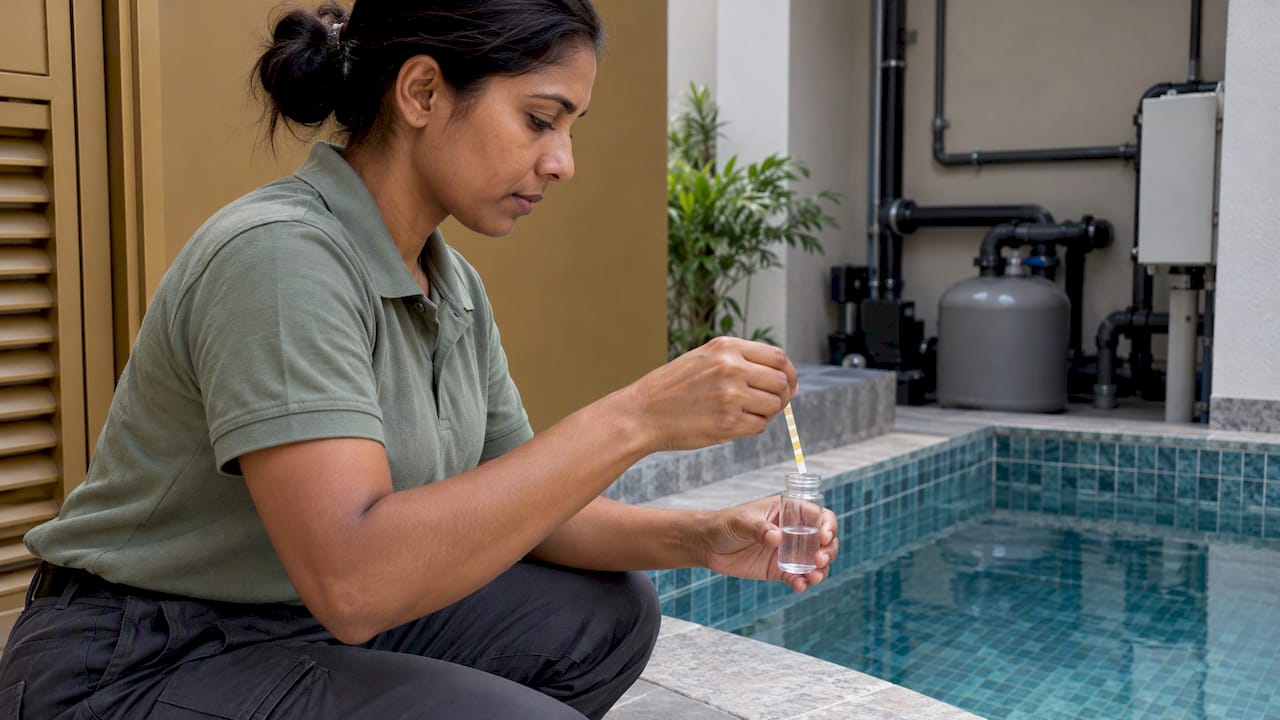
For private homes, regular testing is the sensible baseline. Reporting on the official rules says pool owners in the UAE are expected to test water quality regularly: daily for chlorine and temperature, bi-weekly for comprehensive checks, and microbiological testing every two months. Dubai’s rules for shared pools also expect operators to keep records of installation, maintenance and repair. Even if you own a private pool, keeping a simple log is good practice.
Small volumes concentrate dissolved solids faster. Spa-scale water accumulates total dissolved solids more quickly than larger pools because of its smaller volume and higher evaporation, which means regular testing and periodic drain-and-refill cycles. That is general pool-care guidance, so ask whichever company services your pool what schedule it recommends for your system.
A workable routine looks like this:
- Daily: check temperature and sanitiser level, skim debris, make sure the cover or barrier is in place.
- Weekly: a fuller water test, a check of the filter and pump, and a wipe-down of the waterline and steps.
- Every few months: professional servicing, microbiological testing and a decision on partial water changes.
The easiest way to keep this light is to choose a home where the pool is serviced under a professional arrangement. That way you enjoy the pool rather than manage it.
Our perspective
We design our residences around how people actually live. A private plunge pool earns its place when it makes an ordinary day feel better: a cool dip after a workout, a quiet few minutes before bed, an outdoor space that feels like yours.
We would never sell a plunge pool as medicine, and the evidence does not ask us to. What it supports is modest and valuable: a short-term lift in how relaxed you feel, a pleasant way to recover, and a reason to step outside every day. For a seafront or boutique home, that is exactly the kind of feature that adds to quality of life.
Our approach is boutique-scale development, with private pools, smart-home integration, wellness and fitness amenities and sustainable design planned together rather than added afterwards. That is how a pool stays easy to maintain, safe to use and in proportion with the building around it.
When you view a home with a plunge pool, ask the questions in this guide. A good developer will welcome them.
Mark
See plunge pool living for yourself
If you are comparing homes with private plunge pools, wellness amenities and smart-home features, our two current developments are the place to start. Azure by Lapis and Lazord by Lapis are boutique residential projects in the UAE, and each project page sets out the available units and published starting prices. Speak to our team about which residences include private pool features and what each unit’s specification covers.

You can also read about the community and design thinking behind Lazord’s wellness-led living in Majan, or browse all our off-plan projects. To arrange a viewing or a call, enquire through our website.
FAQ
Are plunge pools good for you?
They can be pleasant and mildly beneficial, but they are not a treatment. The best-supported effects are lower stress in the hours after cold immersion and possible better sleep, according to a 2025 PLOS One meta-analysis. Evidence for immunity or weight loss is weak.
How long should you stay in a plunge pool?
Beginners should start with 1 to 2 minutes, and sessions should stay under 5 minutes, per Cleveland Clinic. Get out straight away if you feel lightheaded or very uncomfortable, and warm up afterwards.
Is a plunge pool good for circulation?
Not in a proven, long-term sense. Cold water constricts skin blood vessels and raises heart rate and blood pressure for a while, which Harvard Health calls an acute change rather than evidence of better circulation. If you have a heart or circulation condition, see your doctor first.
What is the difference between a plunge pool and a jacuzzi?
A plunge pool is a small, deep pool for brief cooling-off dips, while a jacuzzi or hot tub is a warm pool for long soaks, with water up to 104°F (40°C). Hot tubs also need closer water care because water quality drops faster when it is warm.
Can you have a plunge pool in an apartment?
Yes, when it is built into the design of the building. In Dubai, pool plans need Dubai Municipality approval and must meet technical and safety standards before construction, so ask your developer for the approved specification.
Sources
- Effects of cold-water immersion on health and wellbeing, PLOS One (2025)
- Cold plunges: Healthy or harmful for your heart? Harvard Health
- Can a cold plunge improve your health? American Medical Association
- 4 things to know about cold plunges and contrast therapy, American Medical Association
- Cold Water Immersion, Heart Rate Variability and recovery, systematic review (2025)
- Health Benefits of Cold Plunges, Cleveland Clinic
- Cold Plunge Tanks and Pools FAQ, Public Health Ontario
- Pool and spa etiquette and safety guidelines
- Ice Baths and Saunas, American Lung Association
- Coastal and waterside saunas, RNLI and Professor Mike Tipton
- Spa vs Pool Chemistry, AQUA Magazine
- Jacuzzi and hot tub installation in Dubai
- Technical Guidelines for Approval of Swimming Pool Plans, Dubai Municipality
- Private Swimming Pools Safety Guidelines, Dubai Municipality
- Dubai Municipality Services
- UAE pool owner guidelines, Khaleej Times
- Spa and hot tub maintenance guidance