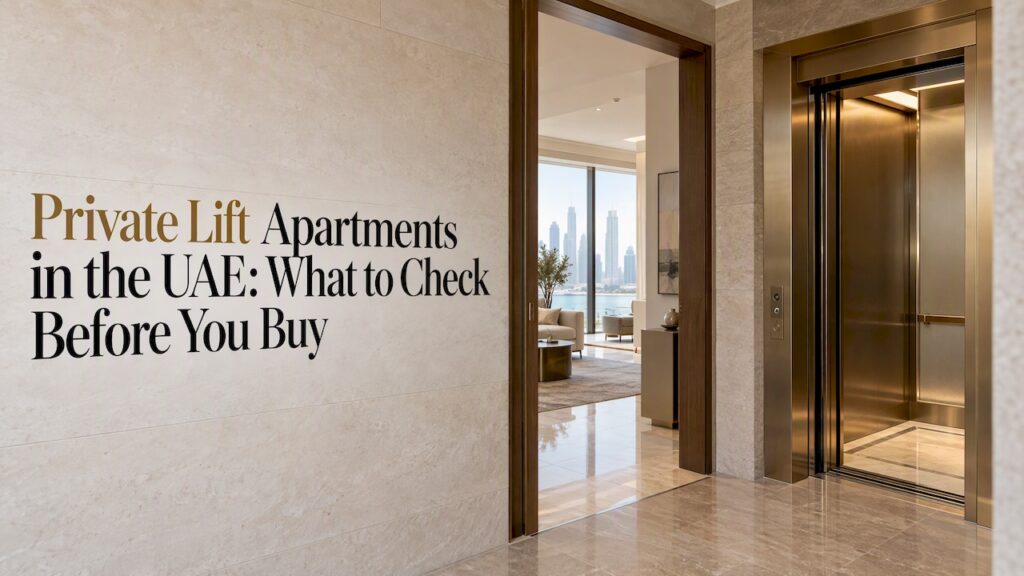
A private lift apartment is a home whose lift is reserved for you: the doors open straight into your residence or a private foyer, and nobody else rides to your floor. In practice the phrase covers several different arrangements, and a listing that says “private lift” does not always mean the same thing. This guide explains the differences, the UAE rules that sit behind lift design, and the questions to put to a developer before you sign.
TL;DR
- A truly private lift is a separate car serving one residence. A key-locked or credential-controlled lift may serve many apartments and simply restrict where each resident can get out.
- Ask four things: who can call the car, where the doors open, what happens in a fire alarm, and who maintains it.
- In Dubai, lift design must follow the Dubai Building Code, and the 2026 building safety law puts weight on inspection and maintenance after handover.
- A private lift is only useful if the whole route works: parking, lobby, corridors and the apartment itself.
- Compare the lift with other features that shape daily life, such as ceiling height, layout, smart-home controls and amenities.
Table of Contents
- What “private lift” really means
- Why buyers want one
- The UAE rules behind lift design
- Safety and maintenance after handover
- Private lift apartment or a home with its own lift?
- A buyer’s checklist
- Look at the whole apartment, not just the lift
- Our perspective
- Explore Lapis Properties developments
- FAQ
- Sources
What “private lift” really means
The term is used loosely in brochures. The clearest explanation comes from CityRealty’s guide to direct-access elevators: a genuinely private elevator is separate from the main building lifts and typically serves one residence, while a key-locked elevator may serve several apartments but lets each resident reach only their own floor. The article is about New York, but the distinction applies to any tall residential building, including those in Dubai and Ras Al Khaimah.
So when you read “private lift”, sort it into one of three types:
| Arrangement | How it works | What you get | What to confirm |
|---|---|---|---|
| Dedicated lift | A separate car serves only your residence or floor | Maximum privacy, no shared rides | Who maintains it and what it costs to service |
| Shared lift, private lobby | A common car opens into a locked vestibule on your floor | Private arrival, shared machinery | Who else can reach the landing |
| Access-controlled lift | Key, card or app limits which floors each resident can use | Security, but you may share the cab | Whether visitors, staff and neighbours can ride with you |
The three-way split is also how specialist penthouse brokers describe the market. The practical conclusion is the same everywhere: “private” is a spectrum, so judge the arrangement itself, not the adjective.
Does it open directly into the apartment?
Sometimes. In a full-floor residence the doors can open into the home itself, or into a small foyer that belongs to you. In most multi-unit buildings the lift opens onto a shared landing, and privacy comes from the access control. Check the floor plan, not the marketing render: look for the lift door, the foyer, the front door and the fire exit on the same drawing.
Why buyers want one
The appeal is not only status. Four benefits come up repeatedly.
Privacy. You arrive without meeting anyone in the cab or corridor. For families with children, high-profile owners and people who work from home, that matters daily.
Convenience. Shopping, luggage, prams and deliveries go from the car park to your door without a stop. Waiting times fall because you are not sharing the car.
Accessibility. Lifts are what make multi-level buildings usable for older relatives, young children and anyone using a wheelchair or a mobility aid. The UAE’s national Universal Design Code names children, elderly people, families and mobility-device users among those who benefit when its accessibility requirements are followed.
Security. A lift that stops only at your floor, and only for credentialed users, adds a layer between the street and your front door. It does not replace building security, but it supports it.
The UAE rules behind lift design
Rules differ by emirate, so be specific about where the building stands.
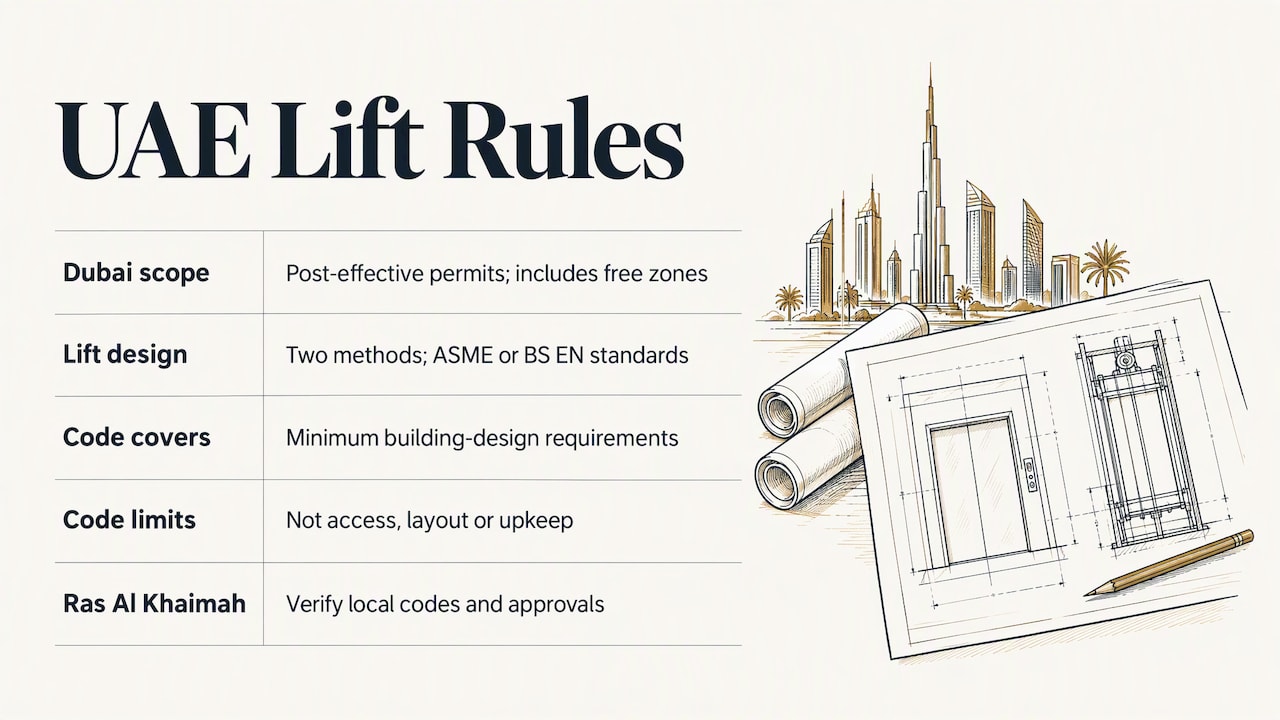
In Dubai, the Dubai Building Code decree applies to building designs for which permits are issued after its effective date, across Dubai, including special development zones and free zones. Dubai Municipality presents the code as setting minimum requirements for building design. For vertical transport, material cited by the Dubai Development Authority says lift designs must follow one of the code’s two design methods and comply with a referenced suite of ASME or BS EN standards.
What does that mean for you? A lift in a new Dubai building is designed to a recognised standard. It does not tell you how the lift is laid out, who can use it or how it will be looked after. Those are commercial and management questions, and they belong in your due diligence.
If you are buying in Ras Al Khaimah, ask the developer which local authority approvals and which codes govern the building, and ask to see the approval documents. We do not assume Dubai’s rules apply there.
Accessibility goes beyond the lift
The Universal Design Code states its purpose as enabling people to approach, enter, use and leave the built environment independently, equitably and with dignity, as far as possible. For multi-occupancy residential buildings, it applies to common parts and expects accessibility to be maintained continuously. The sensible reading for a buyer: do not only ask whether the apartment has a private lift. Ask whether the entrance, lobby, lift, corridors and route to your door work together as one accessible path. Dubai Municipality’s Universal Design Code page also notes that its Wosool service assesses existing buildings against these standards.
Safety and maintenance after handover
A lift is a machine that runs for decades, and it is only as good as its servicing. Dubai’s Law No. 3 of 2026 on the quality and safety of buildings takes a lifecycle view: continued suitability depends on inspection, maintenance and periodic verification of building systems, not only on approval at construction. Its technical assessment framework covers electrical and mechanical installations in common areas and confirmation of Dubai Civil Defence safety requirements.
For a buyer, three practical points follow.
- Find out who pays. In a shared building, lift maintenance is normally funded through service charges. If your lift is dedicated to your residence, ask whether it falls under the common charges or is your own cost.
- Ask for the maintenance arrangement. Who is the service contractor, how often is the lift inspected and where are records kept?
- Ask about fire and emergency behaviour. Lifts are usually recalled or locked out in a fire alarm. Ask where the stairs are, how your floor evacuates and whether a private landing connects to a protected stair.
If you have a specific safety question about a unit, put it in writing to the developer and, for an independent view, to a qualified lift or building services engineer.
Private lift apartment or a home with its own lift?
These are two different purchases that get mixed up in searches.
A private lift apartment sits inside a building with shared structure and shared services. The lift is part of the development, designed and maintained as part of the building. You buy the unit and share the cost of the whole.
A home with its own lift is typically a villa, townhouse or multi-level house where a lift is installed to connect floors inside one property. Here you often have more control over the model, the finish and the servicing, but also more responsibility for it. A home lift is usually a retrofit or a design decision made at the villa stage, and it needs space, structural approval and a service contract of its own.
If you want a lift without a villa’s land, upkeep and cost, an apartment in a boutique tower is often the simpler route. If you want maximum control over the lift itself, a house is the better fit. Neither is automatically better. Choose by how you will live.
A buyer’s checklist
Bring this to every viewing or developer meeting.
On the lift
- Is it a dedicated car, a shared car with a private lobby, or an access-controlled car?
- Who can call it, and who can get out at your landing?
- Do visitors need your approval, a card or a code?
- Is there a back-up for power failure?
- What is the lift’s capacity and cab size? Can it carry furniture, a stretcher or a wheelchair comfortably?
On the layout
- Where does the lift open: into the home, a foyer or a shared landing?
- Is there a separate service entrance?
- How wide are the doors and corridors between lift and living space?
On the paperwork
- Which building code and approvals apply, and may you see the approval documents?
- What is in the service charge, and does it include lift maintenance?
- What do the sales agreement and the handover documents say about the lift’s specification? Treat brochure images as illustrative until the contract confirms them.
- After purchase, make sure you understand your ownership record. Our guide to the title deed in Dubai covers fees, steps and verification.
Look at the whole apartment, not just the lift
A private lift is one feature among many. Judge it alongside the things you will notice every day. Ceiling height changes how a foyer and living room feel, and our high ceilings apartment guide explains what to look for. Cooling costs shape running costs in the UAE climate, so read our notes on energy efficient apartments in Dubai. And if environmental performance matters to you, see what sustainable apartment design means here.
It also pays to think about resale and letting. A private arrival is a strong selling point for a certain kind of buyer, but a well-laid-out home in a well-managed building with good amenities holds appeal for far more people than a single feature does.
Our perspective
We build boutique residential towers, and we think the best arrival experience is one you barely notice: quiet, secure, unhurried, and designed with the rest of the home. Features like smart-home integration, private plunge pools, wellness spaces and premium finishes only feel luxurious when the basics are right. That starts with how you get home.
Our advice to any buyer is simple. Do not buy a label. Ask to see the plan, the access arrangement and the service plan, and ask the same questions of every developer, including us. A boutique scale helps here, because fewer apartments per building means fewer people sharing each landing and a development that is easier to manage well. Whatever the final arrangement in a specific unit, we would rather you saw it in writing before you committed.
— Mark
Explore Lapis Properties developments
We develop luxury residences in Dubai and Ras Al Khaimah, with a focus on boutique scale, sustainable design, smart-home integration and wellness amenities. Lazord by Lapis is our boutique residential project in Majan, Dubailand, and Azure by Lapis is our seafront offering. If lift access and arrival privacy are on your list, tell us. Our team can walk you through the plans and what each unit offers.

To see current availability and payment terms, visit the Lapis Properties homepage and send an enquiry or schedule a call.
FAQ
Is a private lift the same as a key-locked lift?
No. A private lift is a separate car that serves one residence. A key-locked lift may serve many apartments, but each resident can only reach their own floor. Both can give a private arrival, but the second shares the car with neighbours.
Does a private lift open straight into the apartment?
It can, particularly in full-floor homes, but many open into a private foyer or a locked lobby instead. Check the floor plan to see where the lift door, the foyer and the front door sit.
Who pays for maintenance of a private lift in a UAE apartment?
It depends on the building. In many developments lift upkeep sits within the service charge, but a dedicated lift may be treated differently. Ask the developer to confirm in writing, along with the service contractor and inspection schedule.
Are private lifts safe in a fire?
Lifts are generally not used for evacuation during a fire alarm, so you need a protected stair route. Dubai’s safety framework includes confirmation of Civil Defence requirements, and you should ask the developer to show where your floor evacuates.
Is a private lift apartment better than a villa with a home lift?
That depends on how you want to live. An apartment gives you a lift as part of a managed building, while a villa gives you more control but also more responsibility for installation and servicing.
Sources
- CityRealty: direct elevator access in full-floor apartments
- UAE Universal Design Code
- Decree No. 45 of 2021 concerning the Dubai Building Code
- Dubai Municipality: Dubai Building Code
- Dubai Development Authority: code material on vertical transportation
- Dubai Municipality: Dubai Universal Design Code
- Dubai Law No. 3 of 2026 on the quality and safety of buildings