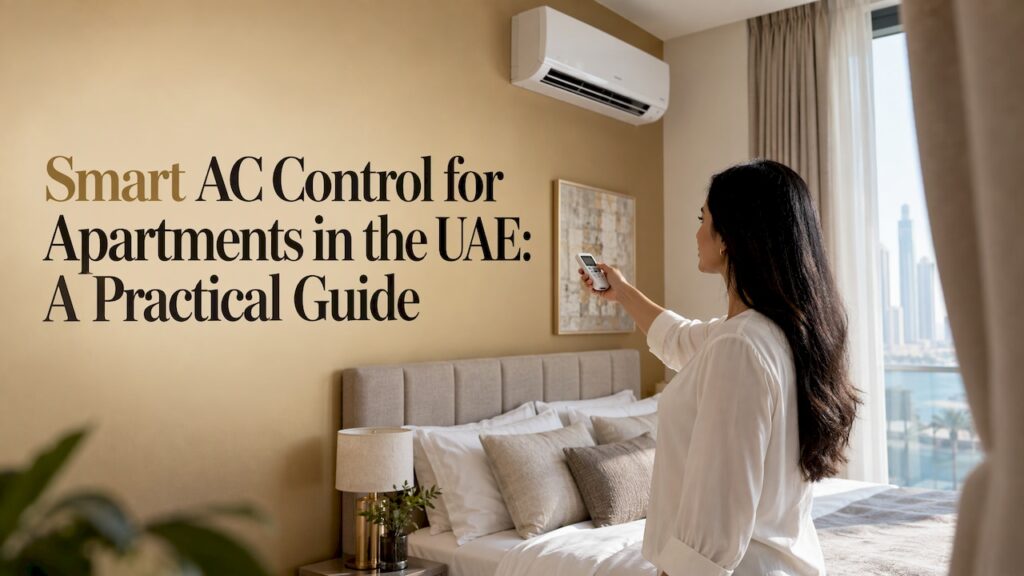
Smart AC control lets you run your apartment’s air conditioning from your phone, a schedule or a voice command, so you can pre-cool before you arrive and stop cooling empty rooms. What you fit depends on your cooling system. A wall-mounted split unit needs a Wi-Fi-to-infrared controller, while a central or district-cooled apartment needs a replacement thermostat, usually installed by an electrician. This guide shows you how to identify your setup, what to ask before you install, and how AC fits into a wider smart apartment.
TL;DR
- First identify your system: split unit with a remote, district-cooled fan coil, or central ducted/VRF. The smart hardware is different for each.
- For split ACs, an infrared controller plugs into a socket and leaves the unit untouched. For wall thermostats, wiring is involved and a professional should do it.
- Anything that alters the electrics or the property needs the landlord’s written consent, and sometimes building or DEWA approval.
- Savings depend on how you are billed, how well the unit is maintained and how you set schedules.
- If you are buying new, ask for smart-home readiness at the design stage, when the wiring is cheapest to plan.
Table of Contents
- What smart AC control actually does
- Know your system before you buy anything
- Smart AC for split units: the simple route
- Central and district-cooled apartments: thermostats and professionals
- Check before you install: landlord, building and DEWA
- Will it save money?
- Beyond the AC: building a smart apartment
- Our perspective
- Smart-ready living at Lapis Properties
- FAQ
- Sources
What smart AC control actually does
A conventional air conditioner does one thing: it holds the temperature you set when you set it. Smart control adds three layers on top.
- Remote control. You change the temperature, mode or fan speed from an app, wherever you are.
- Schedules. The unit cools the bedroom at night and eases off during working hours.
- Context. Location (geofencing), room sensors or a smart-home routine trigger the AC, for example “start cooling when I am 15 minutes away”.
In a climate where an empty apartment can still be hot enough to make arriving home unpleasant, pre-cooling is the feature most residents notice first. One UAE installer’s guide describes the main benefit as an AC that responds to your schedule, location and phone rather than one that only obeys a remote.
How the control is done also matters. With one common design, the smart device replaces the remote and sends your target temperature and settings to the AC, while the AC itself still measures and maintains the room temperature. That is worth knowing: the smart layer is a better remote and a better brain for scheduling, not a replacement compressor.
Know your system before you buy anything
In the UAE, “smart AC” can mean three different setups depending on the cooling equipment. Look at your apartment and match it to one of these.
| Your system | How to recognise it | Typical smart hardware |
|---|---|---|
| Wall-mounted split unit | Indoor unit on the wall, handheld remote, usually billed through your DEWA account | Plug-in Wi-Fi-to-infrared controller |
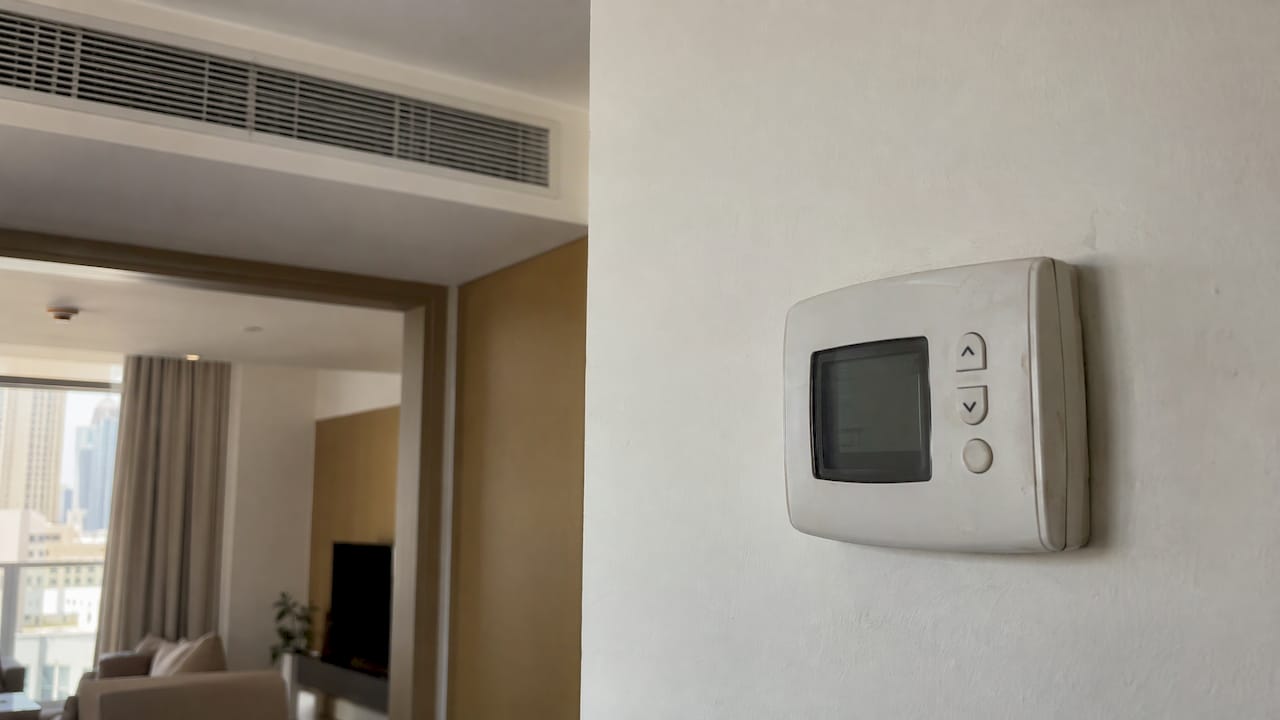
| District-cooled fan coil | Chilled water to a fan coil, wall thermostat, separate cooling bill | Replacement Wi-Fi or KNX fan coil thermostat, wired by an electrician |
| Central ducted or VRF | Ceiling vents or a VRF system, wall controller | Manufacturer’s Wi-Fi adapter or gateway, or a compatible thermostat with correct adapters |
This matches the guidance in a Dubai retailer’s overview: an infrared controller that learns the remote is simplest for splits, a replacement fan coil thermostat suits district-cooled apartments, and ducted or VRF systems use the manufacturer’s adapter or a gateway. Engineering commentary adds that VRF and VRV systems need the manufacturer’s own communication gateway, and that chiller plants are handled at building level.
If you live in a building with building-managed cooling, expect limits. Residents in that situation may only control the local fan coil thermostat, and smart control cannot override restrictions on the building side. If you are unsure which type you have, your building management office or the developer’s handover documents will tell you.
Smart AC for split units: the simple route
Most rental apartments and many older buildings use split units. For these, the usual solution is a small Wi-Fi-to-infrared bridge placed within line of sight of the indoor unit. It learns your remote’s codes and sends them on command.
The practical points:
- The controller plugs into an ordinary wall socket, and installation can take about fifteen minutes with the AC unit left untouched.
- Because nothing is wired into the AC, this is the option most residents can do themselves.
- Home-automation hobbyists commonly use an IR blaster plus a local hub, and note that a stable 2.4 GHz network is a requirement. Many cheap smart devices only join 2.4 GHz networks, so check your router before blaming the device.
- Some AC brands have their own smart option. For example, Samsung Gulf explains that a Samsung AC connects to SmartThings when both devices are on the same 2.4 GHz network and you hold the remote’s Timer button until the AC icon appears in the app.
Place the bridge where it can see the unit, away from direct sunlight, and give each room’s unit its own controller. A one-bridge-per-unit approach avoids the frustration of a signal that does not reach the bedroom.
Central and district-cooled apartments: thermostats and professionals
If your apartment has a wall thermostat, the smart upgrade usually replaces that thermostat. This is where compatibility matters.
US-style smart thermostats are designed around a different electrical standard. One Dubai supplier states that they only work where a conversion adapter is fitted, and that the adapter is not optional. Another UAE guide says that professionally developed smart thermostats are compatible with about 90% of AC systems in the UAE, but only with proper installation and verification, and warns that incorrect wiring can damage the AC unit.
That guide describes a five-step professional process, which is a useful checklist to expect from any installer:
- Compatibility check of the AC system
- Power isolation
- Thermostat wiring and mounting
- Configuration and integration with Wi-Fi and the smart-home hub
- Testing and calibration
Engineering commentary points to where things go wrong: the compatibility check nobody ran, thermostat back-boxes missed on drawings, or AC units commissioned before the automation arrives. The fix is to agree the interface for each unit type at design stage and commission cooling and control together. That is exactly why buying into a new development with smart-home readiness is easier than retrofitting later.
Check before you install: landlord, building and DEWA
A reversible device that leaves no mark is generally something you can fit yourself. One UAE guide for tenants puts the line here: if it alters the property, such as a drilled hole or a wire tapped into the panel, you need the landlord’s written consent, and cabling through a shared riser needs a building No Objection Certificate.
For Dubai specifically, a legal explainer summarises the rules this way:
- DEWA’s regulations say a consumer may not extend or alter the electrical installation without DEWA’s prior approval.
- Dubai’s tenancy law requires a tenant to obtain the landlord’s permission, and any licences needed, before making changes.
- Alterations to jointly owned property in a building need approval from the relevant master developer and authorities.
In practice, a plug-in infrared controller sits comfortably on the reversible side. A replacement wall thermostat does not. Get the consent in writing, and confirm who the installer is and who is responsible if the AC is affected. Rules differ between emirates and communities, so ask your building management for their own requirements.
Privacy is the other check. A smart thermostat is registered to an account, so decide whose. Guidance for renters suggests asking which account the device is registered to, who can access its data and whether cloud features can be disabled. Use a strong unique password and two-factor authentication on the account, and keep device firmware updated.
Will it save money?
Probably, if you use it well, but the size of the saving depends on your situation. Smart control can reduce unnecessary operation through occupancy logic, zoning and coordinated shading. Some installers quote summer savings of 20 to 30 per cent for typical apartments. Treat any such figure as an estimate: your result depends on the unit, your habits and your billing.
The billing structure is the factor most people miss. In district cooling, the bill typically has a metered consumption charge plus a fixed capacity charge based on the apartment’s designed cooling load. Smart scheduling works on the consumption part only. If you are on a DEWA-direct split, the whole electricity bill responds to how your AC runs.
To get the most out of it:
- Set a modest target temperature rather than the lowest the unit allows, and use a schedule that eases off when you are out.
- Pre-cool 15 to 30 minutes before you arrive instead of leaving the AC running all day.
- Keep the AC itself serviced. Smart control cannot replace maintenance: blocked filters, poor airflow or a refrigerant fault still need filter cleaning and professional servicing.
- Use alerts for unusual runtime, which can point to a unit that needs attention.
For a wider look at what makes a home efficient in this climate, see our guide to energy-efficient apartments in Dubai and our explanation of sustainable apartment design in the UAE.
Beyond the AC: building a smart apartment
Air conditioning is usually the first device people automate because it has the clearest daily payoff. After that, a UAE home-automation overview lists lighting, shading and blinds, security and access, audio-visual, irrigation, pool and spa as the other common targets.
The value compounds when these talk to each other. Engineering commentary notes that the benefit of smart AC appears when cooling shares a system with lighting, shading and occupancy, so the home stops cooling empty rooms. Practical routines include:
- Leaving: lights off, blinds down, AC to an eco setpoint.
- Arriving: AC already at temperature, lights on at evening level.
- Night: bedroom AC held steady, other rooms set back.
- Away for days: a holiday mode with a safe temperature and alerts.
A sensible order for a rented or older apartment is: infrared AC controllers first, then smart plugs and bulbs, then a hub (Alexa, Google Home, Apple Home or SmartThings) to link everything. Most of these devices are wireless, and one Dubai integrator notes that most smart home devices retrofit without rewiring, with a full rewire only needed for hardwired lighting systems. Build the network first: a good router or mesh system on 2.4 GHz coverage in every room prevents most reliability complaints.
Our perspective
We design apartments so the smart-home layer is part of the building, not an afterthought. Retrofitting climate control means working around ceilings, wall boxes and building rules that were fixed years earlier. When it is planned from the start, the interface for each AC unit, the thermostat positions and the wiring are settled on the same drawings.
That is why smart-home integration is part of how we approach our boutique residential projects in Dubai and Ras Al Khaimah, alongside premium finishes, wellness amenities and sustainable design. Our aim is homes where cooling, lighting and comfort work together quietly, and where owners do not need a landlord’s permission or a workaround to enjoy them.
If you are choosing between a retrofit and a new home, ask each developer exactly how climate control is integrated, per unit type, before you reserve.
Mark
Smart-ready living at Lapis Properties
If you would rather start with a home designed around smart living than adapt an older one, explore our current developments. Lazord by Lapis in Majan, Dubai, and Azure by Lapis are boutique residential projects with smart-home integration, wellness and fitness amenities and sustainable design practices. You can read the full details on the Lazord by Lapis project page or browse all our off-plan projects.

To see what is included in each home and which units are available, enquire through the project pages and our team will talk you through the options.
FAQ
Can I use a smart thermostat with the AC in my UAE apartment?
Often yes, but the right device depends on your system. Split units use a plug-in infrared controller, while central and district-cooled apartments use a replacement thermostat that should be installed by a professional. US-style thermostats generally need a conversion adapter to work with UAE systems.
Do I need my landlord’s permission?
For a plug-in controller that leaves no mark, usually not, but tell your landlord anyway. For anything that changes the wiring, such as swapping a wall thermostat, you need written consent, and in Dubai DEWA approval and building permissions may also apply. Check your tenancy contract and building management rules first.
Does smart AC control work with Alexa, Google Home or Apple Home?
Most smart thermostats and IR controllers connect to voice assistants and hubs such as SmartThings or HomeKit, so you can build routines like turning the AC off when you leave. Compatibility varies by model, so check the supported platforms before buying. Brand-specific apps, such as Samsung’s SmartThings setup, have their own steps.
Will a smart AC controller lower my bill?
It can, by cutting unnecessary run time through schedules, pre-cooling and presence detection. The effect depends on your billing: in district cooling, the fixed capacity charge does not change, only the consumption part. Regular AC servicing remains essential.
Sources
- Smart AC Control in the UAE: Honest Guide for Apartments
- How does the Smart AC Control V3+ control my air conditioner
- Smart AC Control UAE: Automation and Energy Guide
- Smart AC Controllers and Thermostats in Dubai
- From split ACs to chillers: smart home systems and AC control in the UAE
- Home Assistant in Dubai: Complete Setup Guide
- How to connect a Samsung AC to SmartThings, Samsung Gulf
- Smart Thermostats for UAE Homes: A Guide for 2026
- Smart Home and Security in a Dubai Rental
- Retrofitting a smart home in a Dubai apartment
- Your landlord’s smart devices are watching you, Cybernews
- District Cooling vs DEWA in Dubai: The Two Bills
- What Can Actually Be Automated in a Dubai Home
- Smart Home Automation Dubai